Advertisements
Advertisements
प्रश्न
Choose the correct answer from the options given below
Condition favorable for formation of a covalent bond is
पर्याय
Equal electro negativities of combining atoms
Difference in electron affinities between combining atoms
Atoms should have low ionistation energy
Low nuclear charge and large internuclear distance
Advertisements
उत्तर
Equal electro negativities of combining atoms
संबंधित प्रश्न
Two atoms of the same element combine to form a molecule. The bond between them is known as ______ bond.
What type of chemical bond is present in the chlorine molecule? Explain your answer.
What type of bonding would you expect between the following pair of elements?
Hydrogen and Chlorine
Which of the following has a triple bond as well as single bonds?
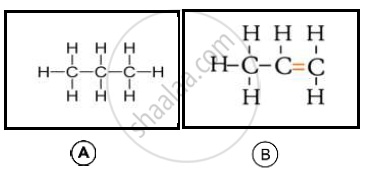
Observe the straight chain hydrocarbons given below and answer the following
questions :
i) Which of the straight chain compounds from A and B is saturated and unsaturated straight chains?
ii) Name these straight chains.
iii) Write their chemical formulae and number of – CH2 - units.
Explain why carbon tetrachloride does not dissolve in water.
In the formation of electrovalent compounds, electrons are transferred from one element to another. How are electrons involved in the formation of a covalent compound?
Name two carbon compounds used in day-to-day life.
Complete the following activity.
Write the names of the hydrocarbons for the following structural formula.
(isobutylene, cyclohexane, propene, cyclohexene, cyclopentane, benzene, propyne, isobutane, propane)
| \[\begin{array}{cc}\ce{H}\phantom{...}\ce{H}\phantom{...}\ce{H}\\ |\phantom{....}|\phantom{....}|\\\ce{H - C - C - C - H}\\ |\phantom{....}|\phantom{....}|\\\ce{H}\phantom{...}\ce{H}\phantom{...}\ce{H} \end{array}\] |
Which of the following compound(s) possesses a high melting point?
