Advertisements
Advertisements
प्रश्न
What type of bonds are present in a water molecule?
Advertisements
उत्तर
The covalent bonds are present in the water molecule.
APPEARS IN
संबंधित प्रश्न
Explain why carbon forms compounds mainly by covalent bond.
Choose the most appropriate answer from the following list of oxides which fit the description.
A covalent oxide of a metalloid.
Name the following:
The property of element by virtue of which atoms of the element can link to each other in the form of a long chain or ring structure.
Name the element whose one of the allotropic forms is buckminsterfullerene.
Write the electron-dot structure for the following molecule:
Cl2
What type of bond is present in the following molecule?
Cl2
Give one example of the following:
A molecule containing a double covalent bond.
In forming oxygen molecule, ______ electrons are shared by each atom of oxygen.
The general formula CnH2n for cycloalkanes is the same as that of ______.
Compare the properties of ionic compounds and covalent compounds.
Why is diamond used for making cutting tools (like glass cutters) but graphite is not?
Friedrich Wohler converted an inorganic compound into an organic compound in the laboratory.
- Give the name and formula of inorganic compound.
- Write the name and formula of organic compound formed.
Draw the electron-dot structure of a hydrogen chloride molecule:
- Which inert gas does the H atom in HCl resemble in electron arrangement?
- Which inert gas does the Cl atom in HCl resemble in electron arrangement?
Draw the electron-dot structure of the following compound and state the type of bonding in the given case:
HCl
Explain why, diamond has a high melting point.
State any two uses of diamond.
Of what substance is graphite made?
Describe the structure of graphite with the help of a labelled diagram.
One of the following contains a double bond as well as single bonds. This is:
A hydrocarbon having one double bond has 100 carbon atoms in its molecule. The number of hydrogen atoms in its molecule will be ______.
Give the formulae of the chlorides of the elements X and Y having atomic numbers of 3 and 6 respectively. Will the properties of the two chlorides be similar or different? Explain your answer.
For each compound mentioned above give the formulae of ions formed in aqueous solution.
Elements forming ionic compounds attain noble gas electronic configuration by either gaining or losing electrons from their valence shells. Explain giving reason why carbon cannot attain such a configuration in this manner to form its compounds. Name the type of bonds formed in ionic compounds and in the compounds formed by carbon. Also explain the reason why carbon compounds are generally poor conductors of electricity.
Draw all possible structural formulae of the compound from its molecular formula given below.
C4H10
Explain the following briefly.
Pure water does not conduct electricity, but on adding sodium chloride to it, it starts conducting electricity.
Explain the structure of Hydronium ion.
Choose the correct answer from the options given below
Which one is not example of polar covalent compound?
(a) Compound X consists of molecules.
Choose the letter corresponding to the correct answer from the choices (a), (b), (c) and (d) given below
In the liquid state, X will
An element L consists of molecules.
Why L is heated with iron metal, it forms a compound FeL. What chemical term would you use to describe the change undergone by L?
The particles present in strong electrolytes are
State the type of bond formed when the combining atom has zero E.N. difference.
Define a covalent bond.
Write scientific reason.
Carbon has the property of forming many compounds.
Complete the following activity.
Write the names of the hydrocarbons for the following structural formula.
(isobutylene, cyclohexane, propene, cyclohexene, cyclopentane, benzene, propyne, isobutane, propane)
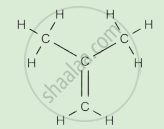 |
Discuss in brief about the properties of coordinate covalent compounds.
Which of the following statements are correct for carbon compounds?
- Most carbon compounds are good conductors of electricity.
- Most carbon compounds are poor conductors of electricity.
- Force of attraction between molecules of carbon compounds is not very strong.
- Force of attraction between molecules of carbon compounds is very strong.
Which of the following compound(s) possesses a high melting point?
In covalent bond formation, the sharing of ______ electrons takes place in their outermost shell.
The electron dot structure of chlorine molecule is:
