Two non-metals combine with each other by the sharing of electrons to form a compound X. (a) What type of chemical bond is present in X? (b) State whether X will have a high melting point or low
Advertisements
Advertisements
प्रश्न
Two non-metals combine with each other by the sharing of electrons to form a compound X.
- What type of chemical bond is present in X?
- State whether X will have a high melting point or low melting point.
- Will it be a good conductor of electricity or not?
- Will it dissolve in an organic solvent or not?
Advertisements
उत्तर
- A covalent bond is present in compound X because it is formed by the sharing of electrons.
- Compound X has a low melting point because it is a covalent compound.
- Being a covalent compound, it will not be a good conductor of electricity.
- Covalent compounds dissolve in an organic solvent. Since X is a covalent compound, it will dissolve in an organic solvent.
APPEARS IN
संबंधित प्रश्न
Elements forming ionic compounds attain noble gas configuration by either gaining or losing electrons from their outermost shells. Give reason to explain why carbon cannot attain noble gas configuration in this manner to form its compounds.
State whether the following statement is true or false:
Diamond and graphite are the covalent compounds of carbon element (C).
Which inert gas electron configuration do the Cl atoms in Cl2 molecule resemble? What is this electron configuration?
Give one example of the following:
A molecule containing a triple covalent bond.
In forming N2 molecule, ______ electrons are shared by each atom of nitrogen.
The number of single covalent bonds in C2H2 molecule are ______.
Why does carbon form compounds mainly by covalent bonding?
Explain why, ionic compounds conduct electricity in solution whereas covalent compounds do not conduct electricity.
Name one covalent compound containing chlorine.
Draw the electron-dot structure of a hydrogen chloride molecule:
- Which inert gas does the H atom in HCl resemble in electron arrangement?
- Which inert gas does the Cl atom in HCl resemble in electron arrangement?
Draw the electron-dot structure of the following compound and state the type of bonding in the given case:
CO2
Out of KCl, HCl, CCl4 and NaCl, the compounds which are not ionic are:
The electronic configurations of three elements X, Y and Z are as follows:
| X | 2, 4 |
| Y | 2, 7 |
| Z | 2, 1 |
- Which two elements will combine to form an ionic compound?
- Which two elements will react to form a covalent compound?
Give reasons for your choice.
The number of carbon atoms joined in a spherical molecule of buckminsterfullerene is ______.
The electronic configurations of two elements A and B are given below:
| A | 2, 6 |
| B | 2, 8, 1 |
- What type of chemical bond is formed between the two atoms of A?
- What type of chemical bond will be formed between the atoms of A and B?
What is the difference between ionic compounds and polar covalent compounds?
For each compound mentioned above give the formulae of ions formed in aqueous solution.
State the type of bonding in the following molecule.
Hydroxyl ion
Complete the following:
When the nuclei of two different reacting atoms are of ______ mass, then a bond so formed is called ______ covalent bond. (equal, unequal, polar, non-polar)
Choose and write the correct option.
Which type of carbon-carbon bonds are present in Vanaspati ghee?
Explain why carbon tetrachloride does not dissolve in water.
In the formation of electrovalent compounds, electrons are transferred from one element to another. How are electrons involved in the formation of a covalent compound?
Electrons are getting added to an element Y:
Is Y getting oxidised or reduced?
Draw the electron dot diagram and structure of magnesium chloride.
What is the difference between :
Ionic compounds and covalent compounds
Potassium chloride is an electrovalent compound, while hydrogen chloride is a covalent compound, But, both conduct electricity in their aqueous solutions. Explain.
Define a covalent bond.
Name the anion present in the following compound:
When a barium chloride solution is added to a solution of compound B, a white precipitate insoluble in dilute hydrochloric acid is formed.
Write the molecular formula of the given compound.
Propylene
Complete the following activity.
Write the names of the hydrocarbons for the following structural formula.
(isobutylene, cyclohexane, propene, cyclohexene, cyclopentane, benzene, propyne, isobutane, propane)
| \[\begin{array}{cc} \phantom{..}\ce{H}\phantom{...}\ce{H}\phantom{...}\ce{H}\\ \phantom{..}|\phantom{....}|\phantom{....}|\\ \ce{H - C - C- C- H}\\ \phantom{.}|\phantom{....}|\phantom{....}|\\ \ce{H - C - H}\\ |\\\ce{H}\end{array}\] |
Complete the following activity.
Write the names of the hydrocarbons for the following structural formula.
(isobutylene, cyclohexane, propene, cyclohexene, cyclopentane, benzene, propyne, isobutane, propane)
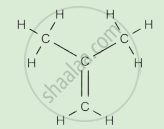 |
Complete the following activity.
Write the names of the hydrocarbons for the following structural formula.
(isobutylene, cyclohexane, propene, cyclohexene, cyclopentane, benzene, propyne, isobutane, propane)
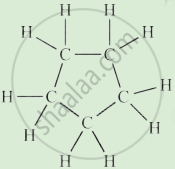 |
List two differences between the properties exhibited by covalent compounds and ionic compounds.
Identify the incorrect statement and correct them.
- Like covalent compounds, coordinate compounds also contain charged particles (ions). So they are good conductors of electricity.
- Ionic bond is a weak bond when compared to Hydrogen bond.
- Ionic or electrovalent bonds are formed by mutual sharing of electrons between atoms.
- Loss of electrons is called Oxidation and gain of electron is called Reduction.
- The electrons which are not involved in bonding are called valence electrons.
An element A is soft and can be cut with a knife. This is very reactive to air and cannot be kept open in air. It reacts vigorously with water. Identify the element from the following
The correct structural formula of butanoic acid is
Mineral acids are stronger acids than carboxylic acids because
- mineral acids are completely ionised
- carboxylic acids are completely ionised
- mineral acids are partially ionised
- carboxylic acids are partially ionised
"Carbon prefers to share its valence electrons with other atoms of carbon or with atoms of other elements rather than gaining or losing the valence electrons in order to attain noble gas configuration." Give reasons to justify this statement.
It is observed that covalent compounds are had conductors of electricity. Give reason.
In covalent compounds, the bond is formed due to ______ of electrons.
