The number of single covalent bonds in C2H2 molecule are ______.
Advertisements
Advertisements
प्रश्न
The number of single covalent bonds in C2H2 molecule are ______.
Advertisements
उत्तर
The number of single covalent bonds in C2H2 molecule are two.
Explanation:
In a C2H2 (acetylene) molecule, the two carbon atoms are joined together by a central triple covalent bond. Each carbon atom also shares a single pair of electrons with a hydrogen atom on either side. This results in exactly two single covalent bonds (the C-H bonds) and one triple bond in the entire molecule.
APPEARS IN
संबंधित प्रश्न
List three characteristic properties of covalent compounds.
State the reason to explain why covalent compounds "are bad conductors of electricity".
Choose the correct answer from the options given below:
Which of the following is a common characteristic of a covalent compound?
1) high melting point
2) consists of molecules
3) always soluble in water
4) Conducts electricity when it is in the molten state
Buckminsterfullerene is a spherical molecule in which 60 carbon atoms are arranged in interlocking hexagonal and pentagonal rings of carbon atoms.
- How many hexagons of carbon atoms are present in one molecule of buckminsterfullerene?
- How many pentagons of carbon atoms are present in one molecule of buckminsterfullerene?
How does graphite act as a lubricant?
State one major difference between covalent and ionic bonds.
What type of bond is present in the following molecule?
CH4
What type of bond is present in the following molecule?
Cl2
Giving one example, state what are covalent compounds.
What is diamond?
Describe the structure of graphite with the help of a labelled diagram.
The atomic numbers of four elements P, Q, R and S are 6, 10, 12 and 17 respectively. Which two elements can combine to form a covalent compound?
The molecules having triple bond in them are ______.
Complete the following:
In case of non-polar covalent bond, the covalent bond is formed in the ______ of atoms and shared electrons are ______ distributed. (corner, middle, equally, unequally)
Give two example in following case:
Gaseous polar covalent compound.
Give two example in following case:
Gaseous non polar covalent compound.
Distinguish between ionic and covalent compounds under the following properties:
(i) Strength of forces between constituent elements
(ii) Solubility of compounds in water
(iii) Electrical conduction in substances
Match the pairs.
| Group 'A' | Group 'B' |
| a. C2H6 | 1. Unsaturated hydrocarbon |
| b. C2H2 | 2. Molecular formula of an alcohol |
| c. CH4O | 3. Saturated hydrocarbon |
| d. C3H6 | 4. Triple bond |
Draw an electron dot structure of the following molecule. (Without showing the circle) :
Water
The carbon compound is used in daily life is ______.
Explain the following briefly.
Pure water does not conduct electricity, but on adding sodium chloride to it, it starts conducting electricity.
Name a neutral covalent molecule which contains one lone pair of electrons.
The electronic configuration of N2 is 2, 5. How many electrons in the outer shell of a N atom are not involved in the formation of a nitrogen molecule?
The following table shows the electronic configuration of the elements W, X, Y, Z:
|
Element |
W |
X |
Y |
Z |
|
Electronic |
2,8,1 |
2,8,7 |
2,5 |
1 |
Answer the following questions based on the table above:
What type of bond is formed between Y and Z.
Which of the following is a common characteristic of a covalent compound?
Name two compounds that are covalent when taken pure but produce ions when dissolved in water.
Potassium (Atomic No. 19) and chlorine (Atomic No. 17) react to form a compound. On the basis of electronic concept, explain
(i) oxidation
(ii) reduction
(iii)oxidising agent
(iv)reducing agent
Define a covalent bond.
Name two carbon compounds used in day-to-day life.
The bond between two oxygen atoms is _______ bond.
Explain covalent bond with example.
Complete the following activity.
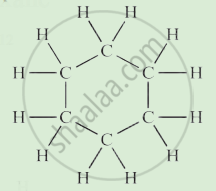
Write the names of the hydrocarbons for the following structural formula.
(isobutylene, cyclohexane, propene, cyclohexene, cyclopentane, benzene, propyne, isobutane, propane)
 |
List two differences between the properties exhibited by covalent compounds and ionic compounds.
Which of the following is the formula of Butanoic acid?
Two carbon atoms can always form one or two covalent bonds.
Oils on treating with hydrogen in the presence of palladium or nickel catalyst form fats. This is an example of
Write notes on the characteristics of covalent compounds.
State the reasons, why carbon cannot
- Lose four electrons to form C4+ cation and
- Gain four electrons to form C4- anion.
How does carbon overcome this problem to form compounds?
