Advertisements
Advertisements
Question
The number of single covalent bonds in C2H2 molecule are ______.
Advertisements
Solution
The number of single covalent bonds in C2H2 molecule are two.
Explanation:
In a C2H2 (acetylene) molecule, the two carbon atoms are joined together by a central triple covalent bond. Each carbon atom also shares a single pair of electrons with a hydrogen atom on either side. This results in exactly two single covalent bonds (the C-H bonds) and one triple bond in the entire molecule.
APPEARS IN
RELATED QUESTIONS
Why covalent compounds are different from ionic compounds?
Explain why carbon forms compounds mainly by covalent bond.
An element L consists of molecules.
What type of bonding is present in the particles that make up L?
What type of bond is present in hydrogen chloride?
What is the atomic number of carbon. Write its electronic configuration.
What is a covalent bond?
Why is diamond used for making cutting tools (like glass cutters) but graphite is not?
Give two general properties of ionic compounds.
Using electron-dot diagrams which show only the outermost shell electrons, show how a molecule of oxygen, O2, is formed from two oxygen atoms. What name is given to this type of bonding?
(At. No. of oxygen = 8)
State one use of diamond which depends on its ‘extraordinary brilliance’ and one use of graphite which depends on its being ‘black and quite soft’.
Of what substance is graphite made?
Why are covalent compounds generally poor conductors of electricity?
An element E exists in three allotropic forms A, B and C. In allotrope A, the atoms of element E are joined to form spherical molecules. In allotrope B, each atom of element E is surrounded by three other E atoms to form a sheet like structure. În allotrope C, each atom of element E is surrounded by four other E atoms to form a rigid structure.
(a) Name the element E.
(b) What is allotrope A.
(c) What is allotrope B?
(d) What is allotrope C?
(e) Which allotrope is used in making jewellery?
(f) Which allotrope is used in making anode of a dry cell?
State the type of bonding in the following molecule.
Water
Give two example in following case:
Solid covalent compounds
Explain the following term with example.
Alkane
Explain the following term with example.
Homopolymer
The carbon compound is used in daily life is ______.
Explain the following briefly:
Sodium chloride dissolves in water but carbon tetra chloride is insoluble in water.
Explain the following briefly:
Cl2 is a non polar molecule, while HCl is a polar molecule.
Give examples for the following:
Two gaseous polar compounds.
Explain the following:
Covalent compounds have low melting and boiling point.
Choose the correct answer from the options given below
Condition favorable for formation of a covalent bond is
Name a neutral covalent molecule which contains one lone pair of electrons.
The particles present in strong electrolytes are
Fill in the blank from the choice given in bracket.
The compound that does not have a lone pair of electrons is ___________. (Water, Ammonia, carbon tetrachloride)
Electrons are getting added to an element Y:
Is Y getting oxidised or reduced?
What do you understand by dipole (polar) molecule?
State the type of bond formed when the combining atom has zero E.N. difference.
Element A has 2 electrons in its M shell. Element B has atomic number 7.
If the compound formed between A and B is melted and an electric current is passed through the molten compound, the element A will be obtained at the ______ and B at the ______ of the electrolytic cell.
Potassium chloride is an electrovalent compound, while hydrogen chloride is a covalent compound, But, both conduct electricity in their aqueous solutions. Explain.
Write an Explanation.
Alkane
Write scientific reason.
Carbon has the property of forming many compounds.
Complete the following activity.
Write the names of the hydrocarbons for the following structural formula.
(isobutylene, cyclohexane, propene, cyclohexene, cyclopentane, benzene, propyne, isobutane, propane)
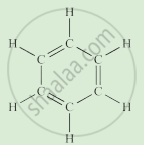 |
Complete the following activity.
Write the names of the hydrocarbons for the following structural formula.
(isobutylene, cyclohexane, propene, cyclohexene, cyclopentane, benzene, propyne, isobutane, propane)
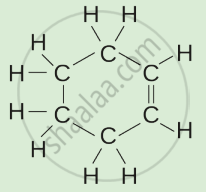 |
Although metals form basic oxides, which of the following metals form an amphoteric oxide?
What is a covalent bond?
