Advertisements
Advertisements
प्रश्न
Potassium (Atomic No. 19) and chlorine (Atomic No. 17) react to form a compound. On the basis of electronic concept, explain
(i) oxidation
(ii) reduction
(iii)oxidising agent
(iv)reducing agent
Advertisements
उत्तर
2K + Cl2→ 2KCl
1.Oxidation: In the electronic concept, oxidation is a process in which an atom or ion loses electron(s).
K → K+ + e-
2.Reduction: In the electronic concept, the reduction is a process in which an atom or ion accepts electron(s).
Cl2 + 2e-→ 2Cl-
iii. Oxidising agent
An oxidising agent oxidises other substances either by accepting electrons or by providing oxygen or an electronegative ion, or by removing hydrogen or an electropositive ion.
Cl2 + 2e-→ 2Cl-
iv.Reducing agent
A reducing agent reduces other substances either by providing electrons or by providing hydrogen or an electropositive ion, or by removing oxygen or an electronegative ion.
K → K+ + e-
संबंधित प्रश्न
State the type of bonding in the following molecule.
Water
Which inert gas does the Cl atom in HCl resemble in electron arrangement?
Draw the electron-dot structure of the following compound and state the type of bonding in the given case:
N2
Give the characteristic properties of covalent compounds.
Explain the following:
Covalent compounds are generally gases or liquids or soft solids.
What is the term defined below?
A bond formed by a shared pair of electrons, each bonding atom contributing one electron to the pair.
Name the anion present in the following compound:
When a barium chloride solution is added to a solution of compound B, a white precipitate insoluble in dilute hydrochloric acid is formed.
Complete the following activity.
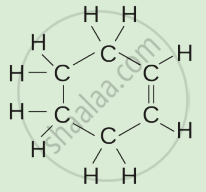
Write the names of the hydrocarbons for the following structural formula.
(isobutylene, cyclohexane, propene, cyclohexene, cyclopentane, benzene, propyne, isobutane, propane)
 |
______ is an example of a covalent compound having a high melting point.
Carbon can neither form C4- cation nor C4 anion. Why?
