Advertisements
Advertisements
प्रश्न
The molecules having triple bond in them are:
(a) oxygen and ethyne
(b) carbon dioxide and ammonia
(c) methane and ethene
(d) nitrogen and ethyne
Advertisements
उत्तर
(d) nitrogen and ethyne
In a nitrogen molecule, each nitrogen atom shares its 3 electrons to form a triple bond among them. In an ethyne molecule, each carbon atom shares 3 electrons to form a triple bond among them.
APPEARS IN
संबंधित प्रश्न
What are covalent compounds?
What would be the electron dot structure of carbon dioxide which has the formula CO2?
Name the following:
The property of element by virtue of which atoms of the element can link to each other in the form of a long chain or ring structure.
Fill in the blank in the following sentence:
In forming N2 molecule, .............. electrons are shared by each atom of nitrogen.
Give the formula of the compound that would be formed by the combination of the following pair of elements:
K and H
What type of bonding would you expect between Hydrogen and Chlorine?
The number of covalent bonds in pentane (molecular formula C5H12) is:
Which of the following has a triple bond as well as single bonds?
(a) ethene
(b) methane
(c) ethyne
(d) nitrogen
You can buy solid air-freshners in shops. Do you think these substance are ionic or covalent? Why?
What are the conditions necessary for the formation of covalent molecules?
Give two example in following case:
Gaseous non polar compounds
Draw electron - dot structure and structural formula of methane.
The covalent bond in which the electrons are shared equally between the combining atoms.
Explain the following:
Covalent compounds have low melting and boiling point.
Write an Explanation.
Alkane
Write a short note.
Characteristics of carbon
Complete the following activity.
Write the names of the hydrocarbons for the following structural formula.
(isobutylene, cyclohexane, propene, cyclohexene, cyclopentane, benzene, propyne, isobutane, propane)
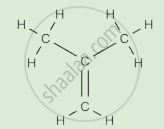 |
Although metals form basic oxides, which of the following metals form an amphoteric oxide?
