Advertisements
Advertisements
प्रश्न
One of the following contains a double bond as well as single bonds. This is:
(a) CO2
(b) O2
(c) C2H4
(d) C2H2
Advertisements
उत्तर
(c) C2H4
An ethene molecule (C2H4) contains one double bond between two carbon atoms and four single bonds between carbon and hydrogen atoms.
APPEARS IN
संबंधित प्रश्न
Butanone is a four-carbon compound with the functional group:
An element L consists of molecules.
What type of bonding is present in the particles that make up L?
How does graphite act as a lubricant?
What type of bonds are present in H2 molecule? Draw their electron-dot structures.
Fill in the blank in the following sentence:
Two chlorine atoms combine to form a molecule. The bond between them is known as ..........
Why does carbon form compounds mainly by covalent bonding?
Draw the electron-dot structure of a hydrogen chloride molecule.
Draw the electron-dot structure of N2 and state the type of bonding.
The molecules having triple bond in them are:
(a) oxygen and ethyne
(b) carbon dioxide and ammonia
(c) methane and ethene
(d) nitrogen and ethyne
Give two example in following case:
Gaseous polar compounds
Explain the following term with example.
Covalent bond
Explain the following term with example.
Unsaturated hydrocarbon
The covalent bond in which the electrons are shared equally between the combining atoms.
Give examples for the following:
Two gaseous polar compounds.
Give examples for the following:
Two gaseous non polar compounds.
Give an example of the covalent bond formed by
(i) Similar atoms (ii) Dissimilar atoms
Complete the following activity.
Write the names of the hydrocarbons for the following structural formula.
(isobutylene, cyclohexane, propene, cyclohexene, cyclopentane, benzene, propyne, isobutane, propane)
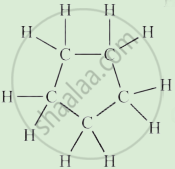 |
Consider the coordination compound, K2[Cu(CN)4]. A coordinate covalent bond exists between:
Which of the following is the formula of Butanoic acid?
Carbon can neither form C4- cation nor C4 anion. Why?
