Advertisements
Advertisements
प्रश्न
The covalent bond in which the electrons are shared equally between the combining atoms.
Advertisements
उत्तर
Non-polar covalent bond
APPEARS IN
संबंधित प्रश्न
Give appropriate scientific reasons for Carbon tetrachloride does not conduct electricity.
What is the atomic number of carbon. Write its electronic configuration.
One of the following compounds is not ionic in nature. This compound is:
Which element exhibits the property of catenation to maximum extent and why?
The following structural formula belongs to which carbon compound?
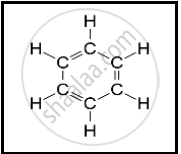
Acids dissolve in water and produce positively charged ions. Draw the structure of these positive ions.
Answer the following question.
What is methane? Draw its electron dot structure. Name the type of bonds formed in this compound. Why are such compounds:
(i) poor conductors of electricity? and
(ii) have low melting and boiling points? What happens when this compound burns in oxygen?
Write a short note.
Characteristics of carbon
Complete the following activity.
Write the names of the hydrocarbons for the following structural formula.
(isobutylene, cyclohexane, propene, cyclohexene, cyclopentane, benzene, propyne, isobutane, propane)
| \[\begin{array}{cc}\ce{H}\phantom{...}\ce{H}\phantom{...}\ce{H}\\ |\phantom{....}|\phantom{....}|\\\ce{H - C - C - C - H}\\ |\phantom{....}|\phantom{....}|\\\ce{H}\phantom{...}\ce{H}\phantom{...}\ce{H} \end{array}\] |
`"CH"_3 - "CH"_2 - "OH" overset("Alkaline""KMnO"_4 + "Heat")(->) "CH"_3 - "COOH"`
In the above given reaction, alkaline KMnO4 acts as
