Advertisements
Advertisements
प्रश्न
Out of KCl, HCl, CCl4 and NaCl, the compounds which are not ionic are:
(a) KCl and HCl
(b) HCl and CCl4
(c) CCl4 and NaCl
(d) KCl and CCl4
Advertisements
उत्तर
(b) HCl and CCl4
Both these compounds are formed by sharing of electrons and hence, they form covalent bonds and not ionic bonds.
APPEARS IN
संबंधित प्रश्न
Write structural formula of Methane.
Choose the correct answer from the options given below:
Which of the following is a common characteristic of a covalent compound?
1) high melting point
2) consists of molecules
3) always soluble in water
4) Conducts electricity when it is in the molten state
Fill in the blank in the following sentence:
Two atoms of the same element combine to form a molecule. The bond between them is known as ................ bond.
Give the formula of the compound that would be formed by the combination of the following pair of elements:
K and H
What type of bonding would you expect between Hydrogen and Chlorine?
Describe the structure of graphite with the help of a labelled diagram.
Why is graphite a good conductor of electricity but diamond is a non-conductor of electricity?
Complete the following:
When the nuclei of two different reacting atoms are of ______ mass, then a bond so formed is called ______ covalent bond. (equal, unequal, polar, non-polar)
Give two example in following case:
Solid covalent compounds
Give two example in following case:
Gaseous non polar compounds
Which element exhibits the property of catenation to maximum extent and why?
Compare the compounds carbon tetrachloride and sodium chloride with regard to solubility in water and electrical conductivity.
Acids dissolve in water and produce positively charged ions. Draw the structure of these positive ions.
Define a covalent bond.
Explain covalent bond with example.
Complete the following activity.
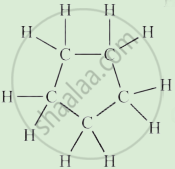
Write the names of the hydrocarbons for the following structural formula.
(isobutylene, cyclohexane, propene, cyclohexene, cyclopentane, benzene, propyne, isobutane, propane)
 |
`"CH"_3 - "CH"_2 - "OH" overset("Alkaline""KMnO"_4 + "Heat")(->) "CH"_3 - "COOH"`
In the above given reaction, alkaline KMnO4 acts as
Write notes on the characteristics of covalent compounds.
"Carbon prefers to share its valence electrons with other atoms of carbon or with atoms of other elements rather than gaining or losing the valence electrons in order to attain noble gas configuration." Give reasons to justify this statement.
