Advertisements
Advertisements
प्रश्न
Out of KCl, HCl, CCl4 and NaCl, the compounds which are not ionic are:
(a) KCl and HCl
(b) HCl and CCl4
(c) CCl4 and NaCl
(d) KCl and CCl4
Advertisements
उत्तर
(b) HCl and CCl4
Both these compounds are formed by sharing of electrons and hence, they form covalent bonds and not ionic bonds.
APPEARS IN
संबंधित प्रश्न
Explain the nature of the covalent bond using the bond formation in CH3Cl.
Write the electron-dot structure for the following molecule.
Cl2
The atomic numbers of four elements P, Q, R and S are 6, 10, 12 and 17 respectively. Which two elements can combine to form a covalent compound?
(a) P and R
(b) Q and S
(c) P and S
(d) R and S
Which of the following has a triple bond as well as single bonds?
(a) ethene
(b) methane
(c) ethyne
(d) nitrogen
A saturated hydrocarbon has fifty hydrogen atom in its molecule. The number of carbon atoms in its molecule will be
(a) twenty five
(b) twenty four
(c) twenty six
(d) twenty seven
Which of the following cannot exhibit isomerism?
(a) C4H10
(b) C5H12
(c) C3H8
(d) C6H14
Draw an electron dot diagram for the formation of the following. State the type of bonding present in them.
Hydroxyl ion
Give two example in following case:
Gaseous non polar compounds
Match the pairs.
| Group 'A' | Group 'B' |
| a. C2H6 | 1. Unsaturated hydrocarbon |
| b. C2H2 | 2. Molecular formula of an alcohol |
| c. CH4O | 3. Saturated hydrocarbon |
| d. C3H6 | 4. Triple bond |
Choose the correct answer from the options given below
Condition favorable for formation of a covalent bond is
Explain why Carbon tetrachloride does not dissolve in water.
Name a neutral covalent molecule which contains one lone pair of electrons.
State the type of bond formed when the combining atom has small E.N. difference.
In the formation of electrovalent compounds, electrons are transferred from one element to another. How are electrons involved in the formation of a covalent compound?
The number of electrons in the valence shell of a carbon atom is 4.
Complete the following activity.
Write the names of the hydrocarbons for the following structural formula.
(isobutylene, cyclohexane, propene, cyclohexene, cyclopentane, benzene, propyne, isobutane, propane)
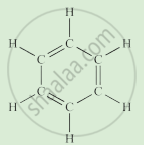 |
Complete the following activity.
Write the names of the hydrocarbons for the following structural formula.
(isobutylene, cyclohexane, propene, cyclohexene, cyclopentane, benzene, propyne, isobutane, propane)
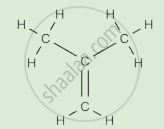 |
Cation is formed when ______.
The I.U.P.A.C name of CH3CH2CH = CH2 is?
