Why does carbon form compounds mainly by covalent bonding?
Advertisements
प्रश्न
Why does carbon form compounds mainly by covalent bonding?
Advertisements
उत्तर
Carbon has the property of tetravalency, so it mainly forms covalent bonds. Since carbon is an element with atomic number 6, its electronic configuration is (2,4). This means there are 4 valence electrons in its outermost shell, and it can either gain 4 electrons or lose 4 electrons to attain the inert gas configuration for becoming stable. As the atoms of carbon are of extremely small size, the nucleus exerts a great force of attraction on the outermost electrons to hold them tightly. This makes it difficult to remove or add electrons to its structure. Therefore, it attains the inert gas configuration by the sharing of electrons in the outermost shell. As the inert gas configuration is attained by the sharing of electrons, carbon forms compounds always by covalent bonding.
APPEARS IN
संबंधित प्रश्न
Explain why carbon forms compounds mainly by covalent bond.
Why are most carbon compounds poor conductors of electricity?
What would be the electron-dot structure of carbon dioxide which has the formula CO2?
What type of bond is present in methane (CH4)?
In forming N2 molecule, ______ electrons are shared by each atom of nitrogen.
What type of chemical bonds are formed by carbon? Why?
State any two uses of graphite.
Buckminsterfullerene is an allotropic form of the element:
A saturated hydrocarbon has fifty hydrogen atoms in its moleucle. The number of carbon atoms in its molecule will be ______.
Define a covalent bond.
What is the difference between ionic compounds and polar covalent compounds?
What do you understand by polar covalent compounds?
Give the characteristic properties of covalent compounds.
Explain the following:
polar covalent compounds electricity.
Complete the following:
When the nuclei of two different reacting atoms are of ______ mass, then a bond so formed is called ______ covalent bond. (equal, unequal, polar, non-polar)
Give two example in following case:
Gaseous polar covalent compound.
Distinguish between ionic and covalent compounds under the following properties:
(i) Strength of forces between constituent elements
(ii) Solubility of compounds in water
(iii) Electrical conduction in substances
Match the pairs.
| Group 'A' | Group 'B' |
| a. C2H6 | 1. Unsaturated hydrocarbon |
| b. C2H2 | 2. Molecular formula of an alcohol |
| c. CH4O | 3. Saturated hydrocarbon |
| d. C3H6 | 4. Triple bond |
Explain the following term with example.
Covalent bond
Give the appropriate term defined by the statement given below:
The covalent bond in which the electrons are shared equally between the combining atoms.
Give examples for the following:
Two gaseous polar compounds.
Give examples for the following:
Two gaseous non polar compounds.
Name a neutral covalent molecule which contains one lone pair of electrons.
In the formation of electrovalent compounds, electrons are transferred from one element to another. How are electrons involved in the formation of a covalent compound?
Compare the compounds carbon tetrachloride and sodium chloride with regard to solubility in water and electrical conductivity.
Which of the following is a common characteristic of a covalent compound?
Compound X consists of molecules.
Choose the letter corresponding to the correct answer from the options A, B, C and D given below:
X is likely to have a ______.
Potassium chloride is an electrovalent compound, while hydrogen chloride is a covalent compound, But, both conduct electricity in their aqueous solutions. Explain.
Explain covalent bond with example.
Complete the following activity.
Write the names of the hydrocarbons for the following structural formula.
(isobutylene, cyclohexane, propene, cyclohexene, cyclopentane, benzene, propyne, isobutane, propane)
| \[\begin{array}{cc} \phantom{..}\ce{H}\phantom{...}\ce{H}\phantom{...}\ce{H}\\ \phantom{..}|\phantom{....}|\phantom{....}|\\ \ce{H - C - C- C- H}\\ \phantom{.}|\phantom{....}|\phantom{....}|\\ \ce{H - C - H}\\ |\\\ce{H}\end{array}\] |
Complete the following activity.
Write the names of the hydrocarbons for the following structural formula.
(isobutylene, cyclohexane, propene, cyclohexene, cyclopentane, benzene, propyne, isobutane, propane)
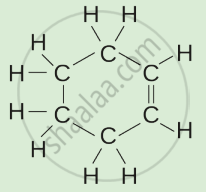 |
The correct structural formula of butanoic acid is -
An element A is soft and can be cut with a knife. This is very reactive to air and cannot be kept open in air. It reacts vigorously with water. Identify the element from the following
`"CH"_3 - "CH"_2 - "OH" overset("Alkaline""KMnO"_4 + "Heat")(->) "CH"_3 - "COOH"`
In the above given reaction, alkaline KMnO4 acts as
Mineral acids are stronger acids than carboxylic acids because
- mineral acids are completely ionised
- carboxylic acids are completely ionised
- mineral acids are partially ionised
- carboxylic acids are partially ionised
The bond which is formed by the mutual sharing of electrons is called ______ bond.
What is a covalent bond?
