Advertisements
Advertisements
Question
Two non-metals combine with each other by the sharing of electrons to form a compound X.
- What type of chemical bond is present in X?
- State whether X will have a high melting point or low melting point.
- Will it be a good conductor of electricity or not?
- Will it dissolve in an organic solvent or not?
Advertisements
Solution
- A covalent bond is present in compound X because it is formed by the sharing of electrons.
- Compound X has a low melting point because it is a covalent compound.
- Being a covalent compound, it will not be a good conductor of electricity.
- Covalent compounds dissolve in an organic solvent. Since X is a covalent compound, it will dissolve in an organic solvent.
APPEARS IN
RELATED QUESTIONS
Write the number of covalent bonds in the molecule of butane, C4H10.
List three characteristic properties of covalent compounds.
Ethane, with the molecular formula C2H6 has ______.
Give appropriate scientific reasons for Carbon tetrachloride does not conduct electricity.
Name the element whose one of the allotropic forms is buckminsterfullerene.
Write the electron-dot structure for the following molecule:
Cl2
What type of bond is present in oxygen?
Give the formula of the compound that would be formed by the combination of the following pair of elements:
Al and Cl2
Which inert gas does the Cl atom in HCl resemble in electron arrangement?
Draw the electron-dot structure of the following compound and state the type of bonding in the given case:
HCl
Draw the electron-dot structure of the following compound and state the type of bonding in the given case:
N2
State any two uses of diamond.
What is graphite?
The number of covalent bonds in pentane (molecular formula C5H12) is ______.
One of the following is not an allotrope of carbon. This is:
An element A has 4 valence electrons in its atom whereas element B has only one valence electron in its atom. The compound formed by A and B does not conduct electricity. What is the nature of chemical bond in the compound formed? Give its electron-dot structure.
A solid element X has four electrons in the outermost shell of its atom. An allotrope Y of this element is used as a dry lubricant in machinery and also in making pencil leads.
(a) What is element X?
(b) Name the allotrope Y.
(c) State whether allotrope Y is a good conductor or non-conductor of electricity.
(d) Name one use of allotrope Y (other than lubrication and pencil leads)
(e) Name two other allotropes of element X.
Define a covalent bond.
Which element exhibits the property of catenation to maximum extent and why?
Distinguish between ionic and covalent compounds under the following properties:
(i) Strength of forces between constituent elements
(ii) Solubility of compounds in water
(iii) Electrical conduction in substances
Match the pairs.
| Group 'A' | Group 'B' |
| a. C2H6 | 1. Unsaturated hydrocarbon |
| b. C2H2 | 2. Molecular formula of an alcohol |
| c. CH4O | 3. Saturated hydrocarbon |
| d. C3H6 | 4. Triple bond |
Draw an electron dot structure of the following molecule. (Without showing the circle) :
Water
Explain the following term with example.
Homopolymer
Explain the following briefly.
Pure water does not conduct electricity, but on adding sodium chloride to it, it starts conducting electricity.
Compare the compounds carbon tetrachloride and sodium chloride with regard to solubility in water and electrical conductivity.
Electrons are getting added to an element Y.
- Is Y getting oxidized or reduced?
- Which electrode will Y migrate to during the process of electrolysis?
State the type of bond formed when the combining atom has zero E.N. difference.
Potassium (Atomic No. 19) and chlorine (Atomic No. 17) react to form a compound. On the basis of electronic concept, explain
(i) oxidation
(ii) reduction
(iii)oxidising agent
(iv)reducing agent
Complete the following activity.
Write the names of the hydrocarbons for the following structural formula.
(isobutylene, cyclohexane, propene, cyclohexene, cyclopentane, benzene, propyne, isobutane, propane)
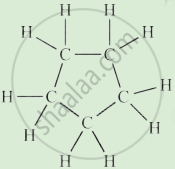 |
Complete the following activity.
Write the names of the hydrocarbons for the following structural formula.
(isobutylene, cyclohexane, propene, cyclohexene, cyclopentane, benzene, propyne, isobutane, propane)
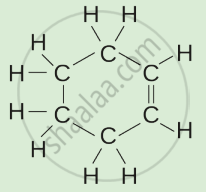 |
Considering MgCl2 as ionic compound and CH4 as covalent compound give any two differences between these two compounds.
When ethyl alcohol and acetic acid are mixed, the resulting ester has a chemical formula ______.
The correct structural formula of butanoic acid is -
Cation is formed when ______.
Which of the following is the formula of Butanoic acid?
`"CH"_3 - "CH"_2 - "OH" overset("Alkaline""KMnO"_4 + "Heat")(->) "CH"_3 - "COOH"`
In the above given reaction, alkaline KMnO4 acts as
Mineral acids are stronger acids than carboxylic acids because
- mineral acids are completely ionised
- carboxylic acids are completely ionised
- mineral acids are partially ionised
- carboxylic acids are partially ionised
______ is an example of a covalent compound having a high melting point.
