Advertisements
Advertisements
प्रश्न
Two non-metals combine with each other by the sharing of electrons to form a compound X.
- What type of chemical bond is present in X?
- State whether X will have a high melting point or low melting point.
- Will it be a good conductor of electricity or not?
- Will it dissolve in an organic solvent or not?
Advertisements
उत्तर
- A covalent bond is present in compound X because it is formed by the sharing of electrons.
- Compound X has a low melting point because it is a covalent compound.
- Being a covalent compound, it will not be a good conductor of electricity.
- Covalent compounds dissolve in an organic solvent. Since X is a covalent compound, it will dissolve in an organic solvent.
APPEARS IN
संबंधित प्रश्न
State the reason to explain why covalent compounds "are bad conductors of electricity".
What would be the electron dot structure of carbon dioxide which has the formula CO2?
An element L consists of molecules.
What type of bonding is present in the particles that make up L?
What do you call the compounds having the same molecular formula but different structural arrangements of atoms?
Give one example of the following:
A molecule containing a single covalent bond.
Two atoms of the same element combine to form a molecule. The bond between them is known as ______ bond.
In forming N2 molecule, ______ electrons are shared by each atom of nitrogen.
The general formula CnH2n for cycloalkanes is the same as that of ______.
What is a covalent bond?
What type of chemical bonds are formed by carbon? Why?
Explain why:
Covalent compounds have generally low melting points.
Explain why, diamond is hard while graphite is soft (though both are made of carbon atoms).
Explain why, graphite can be used as a lubricant but diamond cannot.
Of what substance is graphite made?
Buckminsterfullerene is an allotropic form of the element:
What is the difference between ionic compounds and polar covalent compounds?
Methane molecule is non-polar molecule. Explain.
Give the characteristic properties of covalent compounds.
For each compound mentioned above give the formulae of ions formed in aqueous solution.
Draw an electron dot diagram for the formation of the following. State the type of bonding present in them.
Hydroxyl ion
Give two example in following case:
Gaseous polar covalent compound.
Write answer as directed.
Saturated hydrocarbons are classified into three types. Write these names giving one example each.
Molecular formula of Propane is C3H8 , write the structural formula of propane.
Explain the following briefly:
Sodium chloride dissolves in water but carbon tetra chloride is insoluble in water.
The electronic configuration of N2 is 2, 5. How many electrons in the outer shell of a N atom are not involved in the formation of a nitrogen molecule?
What are the term defined below?
A bond formed by share pair of electrons, each bonding atom contributing one electron to the pair.
State the type of bond formed when the combining atom has small E.N. difference.
Element A has 2 electrons in its M shell. Element B has atomic number 7.
If the compound formed between A and B is melted and an electric current is passed through the molten compound, the element A will be obtained at the ______ and B at the ______ of the electrolytic cell.
Covalent bonds can be single, double or triple covalent bonds. How many electrons are shared in each? Give an example of each type.
Name two carbon compounds used in day-to-day life.
Write scientific reason.
Carbon has the property of forming many compounds.
Write a short note.
Characteristics of carbon
Complete the following activity.
Write the names of the hydrocarbons for the following structural formula.
(isobutylene, cyclohexane, propene, cyclohexene, cyclopentane, benzene, propyne, isobutane, propane)
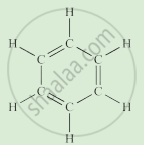 |
Complete the following activity.
Write the names of the hydrocarbons for the following structural formula.
(isobutylene, cyclohexane, propene, cyclohexene, cyclopentane, benzene, propyne, isobutane, propane)
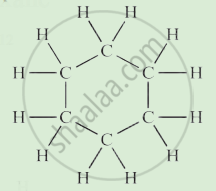 |
When ethyl alcohol and acetic acid are mixed, the resulting ester has a chemical formula ______.
Cation is formed when ______.
The correct structural formula of butanoic acid is
It is observed that covalent compounds are had conductors of electricity. Give reason.
