Advertisements
Advertisements
प्रश्न
Describe the structure of diamond. Draw a s imple diagram to show the arrangement of carbon atoms in diamond.
Advertisements
उत्तर
A crystal of diamond is a molecule of carbon atoms in which each carbon atom is connected to four other carbon atoms by strong covalent bonds forming a regular tetrahedron. As the carbon atoms are held together firmly by covalent bonds, diamond forms a very rigid structure.
The arrangement of carbon atoms in a diamond crystal is shown below:

APPEARS IN
संबंधित प्रश्न
Explain why carbon forms compounds mainly by covalent bond.
State the reason to explain why covalent compounds "are bad conductors of electricity".
What would be the electron dot structure of carbon dioxide which has the formula CO2?
Choose the most appropriate answer from the following list of oxides which fit the description.
A covalent oxide of a metalloid.
Name the following:
The property of element by virtue of which atoms of the element can link to each other in the form of a long chain or ring structure.
Write any three features and give two examples of covalent compounds
State whether the following statement is true or false:
Diamond and graphite are the covalent compounds of carbon element (C).
Name a carbon containing molecule which has two double bonds.
What type of bond is present in the following molecule?
Cl2
Two atoms of the same element combine to form a molecule. The bond between them is known as ______ bond.
What type of chemical bonds are formed by carbon? Why?
What type of bond is present in oxygen?
Why does carbon form compounds mainly by covalent bonding?
What type of chemical bond is present in the chlorine molecule? Explain your answer.
What type of bonding would you expect between the following pair of elements?
Carbon and Chlorine
Draw the electron-dot structure of the following compound and state the type of bonding in the given case:
N2
Explain why, diamond has a high melting point.
One of the following contains a double bond as well as single bonds. This is:
Which of the following cannot exhibit isomerism?
The number of carbon atoms joined in a spherical molecule of buckminsterfullerene is ______.
The electronic configurations of two elements A and B are given below:
| A | 2, 6 |
| B | 2, 8, 1 |
- What type of chemical bond is formed between the two atoms of A?
- What type of chemical bond will be formed between the atoms of A and B?
What is the difference between ionic compounds and polar covalent compounds?
State the type of bonding in the following molecule.
Water
State the type of bonding in the following molecule.
Methane
Give two example in following case:
Gaseous polar covalent compound.
Give two example in following case:
Liquid non polar covalent compound.
Write answer as directed.
Saturated hydrocarbons are classified into three types. Write these names giving one example each.
Molecular formula of Propane is C3H8 , write the structural formula of propane.
Give examples for the following:
Two gaseous polar compounds.
(a) Compound X consists of molecules.
Choose the letter corresponding to the correct answer from the choices (a), (b), (c) and (d) given below
The type of bonding in X will be
Name two compounds that are covalent when taken pure but produce ions when dissolved in water.
Give an example of the covalent bond formed by
(i) Similar atoms (ii) Dissimilar atoms
In the formation of electrovalent compounds, electrons are transferred from one element to another. How are electrons involved in the formation of a covalent compound?
Name the types of Hydrocarbons.
The number of electrons in the valence shell of a carbon atom is 4.
Write scientific reason.
Carbon has the property of forming many compounds.
Complete the following activity.
Write the names of the hydrocarbons for the following structural formula.
(isobutylene, cyclohexane, propene, cyclohexene, cyclopentane, benzene, propyne, isobutane, propane)
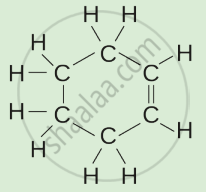 |
When ethyl alcohol and acetic acid are mixed, the resulting ester has a chemical formula ______.
Which of the following compounds of carbon does not consist of ions?
Oils on treating with hydrogen in the presence of palladium or nickel catalyst form fats. This is an example of
