The electronic configurations of two elements A and B are given below: A 2, 6 B 2, 8, 1 (a) What type of chemical bond is formed between the two atoms of A? (b) What type of chemical bond will be
Advertisements
Advertisements
प्रश्न
The electronic configurations of two elements A and B are given below:
| A | 2, 6 |
| B | 2, 8, 1 |
- What type of chemical bond is formed between the two atoms of A?
- What type of chemical bond will be formed between the atoms of A and B?
Advertisements
उत्तर
- Two atoms of A will form a covalent bond. Element A has 6 valence electrons and needs 2 more to complete its octet. Two atoms of A share two electrons each to form a stable double covalent bond (A=A).
- Element A and Element B will form an ionic bond. Element B (2, 8, 1) transfers its 1 valence electron to Element A (2, 6). Since A requires 2 electrons, two atoms of B are needed to transfer 1 electron each to one atom of A, creating a compound with the formula (B2A).
APPEARS IN
संबंधित प्रश्न
Choose the most appropriate answer from the following list of oxides which fit the description.
A covalent oxide of a metalloid.
Name the element whose one of the allotropic forms is buckminsterfullerene.
Buckminsterfullerene is a spherical molecule in which 60 carbon atoms are arranged in interlocking hexagonal and pentagonal rings of carbon atoms.
- How many hexagons of carbon atoms are present in one molecule of buckminsterfullerene?
- How many pentagons of carbon atoms are present in one molecule of buckminsterfullerene?
What would be the electron-dot structure of carbon dioxide which has the formula CO2?
Write the electron-dot structure for the following molecule:
Cl2
State one major difference between covalent and ionic bonds.
What type of bond is present in the following molecule?
CH4
Which inert gas electron configuration do the Cl atoms in Cl2 molecule resemble? What is this electron configuration?
What type of bond exists in CCl4?
Name one covalent compound containing chlorine.
How will you find out which of the water soluble compound A or B is ionic?
Which inert gas does the H atom in HCl resemble in electron arrangement?
Explain why, diamond can be used in rock drilling equipment but graphite cannot.
State one use of diamond which depends on its ‘extraordinary brilliance’ and one use of graphite which depends on its being ‘black and quite soft’.
The solution of one of the following compounds will not conduct electricity. This compound is:
The electronic configurations of three elements X, Y and Z are as follows:
| X | 2, 4 |
| Y | 2, 7 |
| Z | 2, 1 |
- Which two elements will combine to form an ionic compound?
- Which two elements will react to form a covalent compound?
Give reasons for your choice.
An element A has 4 valence electrons in its atom whereas element B has only one valence electron in its atom. The compound formed by A and B does not conduct electricity. What is the nature of chemical bond in the compound formed? Give its electron-dot structure.
You can buy solid air-freshners in shops. Do you think these substances are ionic or covalent? Why?
What is the difference between ionic compounds and polar covalent compounds?
Draw an electron dot structure of the following molecule. (Without showing the circle) :
Methane
Draw all possible structural formulae of the compound from its molecular formula given below.
C3H4
Explain the following term with example.
Hetero atom in a carbon compound
Choose the correct answer from the options given below
Condition favorable for formation of a covalent bond is
What do you understand by dipole (polar) molecule?
Covalent bonds can be single, double or triple covalent bonds. How many electrons are shared in each? Give an example of each type.
Name a greenish-yellow gas which also bleaches.
What are Allotropes? Name any two allotropic forms of carbon. Give one use of it.
Answer the following question.
What is methane? Draw its electron dot structure. Name the type of bonds formed in this compound. Why are such compounds:
(i) poor conductors of electricity? and
(ii) have low melting and boiling points? What happens when this compound burns in oxygen?
The bond between two oxygen atoms is _______ bond.
Write a short note.
Characteristics of carbon
Complete the following activity.
Write the names of the hydrocarbons for the following structural formula.
(isobutylene, cyclohexane, propene, cyclohexene, cyclopentane, benzene, propyne, isobutane, propane)
| \[\begin{array}{cc} \phantom{.........}\ce{H}\\ \phantom{.........}|\\ \ce{H - C ≡ C - C - H}\\ \phantom{.........}|\\ \phantom{.........}\ce{H} \end{array}\] |
Complete the following activity.
Write the names of the hydrocarbons for the following structural formula.
(isobutylene, cyclohexane, propene, cyclohexene, cyclopentane, benzene, propyne, isobutane, propane)
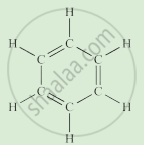 |
Complete the following activity.
Write the names of the hydrocarbons for the following structural formula.
(isobutylene, cyclohexane, propene, cyclohexene, cyclopentane, benzene, propyne, isobutane, propane)
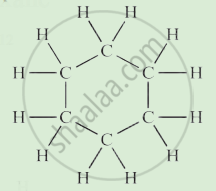 |
Give an example for each of the following statement.
A compound in which three covalent bonds are formed.
Identify the incorrect statement and correct them.
- Like covalent compounds, coordinate compounds also contain charged particles (ions). So they are good conductors of electricity.
- Ionic bond is a weak bond when compared to Hydrogen bond.
- Ionic or electrovalent bonds are formed by mutual sharing of electrons between atoms.
- Loss of electrons is called Oxidation and gain of electron is called Reduction.
- The electrons which are not involved in bonding are called valence electrons.
An element A is soft and can be cut with a knife. This is very reactive to air and cannot be kept open in air. It reacts vigorously with water. Identify the element from the following
Molecular reactions are ______ in the covalent compound.
Statement (A): Covalent compounds are bad conductors of electricity.
Reason (B): Covalent compounds contain charged particles (ions)
Non-polar covalent compounds are ______ conductors of heat and electricity.
