Which inert gas electron configuration do the Cl atoms in Cl2 molecule resemble? What is this electron configuration?
Advertisements
Advertisements
प्रश्न
Which inert gas electron configuration do the Cl atoms in Cl2 molecule resemble? What is this electron configuration?
Advertisements
उत्तर
The chlorine (Cl) atoms in a (Cl2) molecule share a pair of electrons to complete their outer octets. By doing so, each Cl atom resembles the electron configuration of the noble gas argon (Ar). The electronic configuration is 2, 8, 8.
APPEARS IN
संबंधित प्रश्न
List three characteristic properties of covalent compounds.
What would be the electron dot structure of a molecule of sulphur which is made up of eight atoms of sulphur? (Hint – the eight atoms of sulphur are joined together in the form of a ring.)
Buckminsterfullerene is spherical molecule in which 60 carbon atoms are arranged in interlocking hexagonal and pentagonal rings of carbon atoms.
How many pentagons of carbon atoms are present in one molecule of buckminsterfullerene?
What would be the electron-dot structure of carbon dioxide which has the formula CO2?
Explain why:
Covalent compounds have generally low melting points.
What is buckminsterfullerene?
The atomic numbers of four elements P, Q, R and S are 6, 10, 12 and 17 respectively. Which two elements can combine to form a covalent compound?
The solution of one of the following compounds will not conduct electricity. This compound is:
Two non-metals combine with each other by the sharing of electrons to form a compound X.
- What type of chemical bond is present in X?
- State whether X will have a high melting point or low melting point.
- Will it be a good conductor of electricity or not?
- Will it dissolve in an organic solvent or not?
An element E exists in three allotropic forms A, B and C. In allotrope A, the atoms of element E are joined to form spherical molecules. In allotrope B, each atom of element E is surrounded by three other E atoms to form a sheet like structure. În allotrope C, each atom of element E is surrounded by four other E atoms to form a rigid structure.
(a) Name the element E.
(b) What is allotrope A.
(c) What is allotrope B?
(d) What is allotrope C?
(e) Which allotrope is used in making jewellery?
(f) Which allotrope is used in making anode of a dry cell?
What are the conditions necessary for the formation of covalent molecules?
Give two example in following case:
Liquid non polar covalent compound.
Which element exhibits the property of catenation to maximum extent and why?
Elements forming ionic compounds attain noble gas electronic configuration by either gaining or losing electrons from their valence shells. Explain giving reason why carbon cannot attain such a configuration in this manner to form its compounds. Name the type of bonds formed in ionic compounds and in the compounds formed by carbon. Also explain the reason why carbon compounds are generally poor conductors of electricity.
Distinguish between ionic and covalent compounds under the following properties:
(i) Strength of forces between constituent elements
(ii) Solubility of compounds in water
(iii) Electrical conduction in substances
Match the pairs.
| Group 'A' | Group 'B' |
| a. C2H6 | 1. Unsaturated hydrocarbon |
| b. C2H2 | 2. Molecular formula of an alcohol |
| c. CH4O | 3. Saturated hydrocarbon |
| d. C3H6 | 4. Triple bond |
Write answer as directed.
What causes the existance of very large number of carbon compound ?
The following structural formula belongs to which carbon compound?
Draw electron - dot structure and structural formula of methane.
Molecular formula of Propane is C3H8 , write the structural formula of propane.
Explain the following briefly:
Cl2 is a non polar molecule, while HCl is a polar molecule.
Explain the structure of Hydronium ion.
Give a reason as to why hydrogen chloride can be termed as a polar covalent compound.
Compound X consists of molecules.
Choose the letter corresponding to the correct answer from the options A, B, C and D given below:
X is likely to have a ______.
Draw the electron dot diagram and structure of nitrogen molecule.
Draw the electron dot structure of the covalent compound methane (non polar) and HCl (polar) and give two difference between them.
Name two carbon compounds used in day-to-day life.
Complete the following activity.
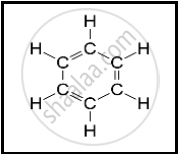
Write the names of the hydrocarbons for the following structural formula.
(isobutylene, cyclohexane, propene, cyclohexene, cyclopentane, benzene, propyne, isobutane, propane)
| \[\begin{array}{cc} \phantom{.........}\ce{H}\\ \phantom{.........}|\\ \ce{H - C ≡ C - C - H}\\ \phantom{.........}|\\ \phantom{.........}\ce{H} \end{array}\] |
Complete the following activity.
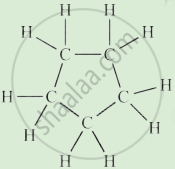
Write the names of the hydrocarbons for the following structural formula.
(isobutylene, cyclohexane, propene, cyclohexene, cyclopentane, benzene, propyne, isobutane, propane)
 |
Give an example for each of the following statement
A compound in which two Covalent bonds are formed.
Cation is formed when ______.
Two carbon atoms can always form one or two covalent bonds.
Carbon forms four covalent bonds by sharing its four valence electrons with four univalent atoms, e.g. hydrogen. After the formation of four bonds, carbon attains the electronic configuration of
The table shows the electronic structures of four elements.
| Element | Electronic Structure |
| P | 2, 6 |
| Q | 2, 8, 1 |
| R | 2, 8, 7 |
| S | 2, 8, 8 |
- Identify which element(s) will form covalent bonds with carbon.
- “Carbon reacts with an element in the above table to form several compounds.” Give suitable reason.
What is a covalent bond?
State the reasons, why carbon cannot
- Lose four electrons to form C4+ cation and
- Gain four electrons to form C4- anion.
How does carbon overcome this problem to form compounds?
Assertion (A): Melting point and boiling point of ethanol are lower than that of sodium chloride.
Reason (R): The forces of attraction between the molecules of ionic compounds are very strong.
