The electronic configurations of two elements A and B are given below: A 2, 6 B 2, 8, 1 (a) What type of chemical bond is formed between the two atoms of A? (b) What type of chemical bond will be
Advertisements
Advertisements
Question
The electronic configurations of two elements A and B are given below:
| A | 2, 6 |
| B | 2, 8, 1 |
- What type of chemical bond is formed between the two atoms of A?
- What type of chemical bond will be formed between the atoms of A and B?
Advertisements
Solution
- Two atoms of A will form a covalent bond. Element A has 6 valence electrons and needs 2 more to complete its octet. Two atoms of A share two electrons each to form a stable double covalent bond (A=A).
- Element A and Element B will form an ionic bond. Element B (2, 8, 1) transfers its 1 valence electron to Element A (2, 6). Since A requires 2 electrons, two atoms of B are needed to transfer 1 electron each to one atom of A, creating a compound with the formula (B2A).
APPEARS IN
RELATED QUESTIONS
Why covalent compounds are different from ionic compounds?
Give reason why carbon compounds are generally poor conductors of electricity.
State the reason why carbon can neither form C4+ cations nor C4− anions but forms covalent compounds.
Name the element whose one of the allotropic forms is buckminsterfullerene.
Buckminsterfullerene is a spherical molecule in which 60 carbon atoms are arranged in interlocking hexagonal and pentagonal rings of carbon atoms.
- How many hexagons of carbon atoms are present in one molecule of buckminsterfullerene?
- How many pentagons of carbon atoms are present in one molecule of buckminsterfullerene?
Name the hardest natural substance known.
In forming oxygen molecule, ______ electrons are shared by each atom of oxygen.
The number of single covalent bonds in C2H2 molecule are ______.
What type of bond exists in CCl4?
Draw the electron-dot structure of the following compound and state the type of bonding in the given case:
H2O
Which of the following has a triple bond as well as single bonds?
An element A has 4 valence electrons in its atom whereas element B has only one valence electron in its atom. The compound formed by A and B does not conduct electricity. What is the nature of chemical bond in the compound formed? Give its electron-dot structure.
Methane molecule is non-polar molecule. Explain.
Explain the following:
polar covalent compounds electricity.
Elements forming ionic compounds attain noble gas electronic configuration by either gaining or losing electrons from their valence shells. Explain giving reason why carbon cannot attain such a configuration in this manner to form its compounds. Name the type of bonds formed in ionic compounds and in the compounds formed by carbon. Also explain the reason why carbon compounds are generally poor conductors of electricity.
Draw an electron dot structure of the following molecule. (Without showing the circle) :
Methanol
Explain the Structural isomerism term with example.
Explain the following term with example.
Alkane
Draw electron - dot structure and structural formula of methane.
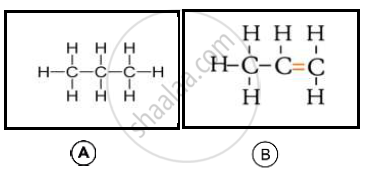
Observe the straight chain hydrocarbons given below and answer the following
questions :
i) Which of the straight chain compounds from A and B is saturated and unsaturated straight chains?
ii) Name these straight chains.
iii) Write their chemical formulae and number of – CH2 - units.
(a) Compound X consists of molecules.
Choose the letter corresponding to the correct answer from the choices (a), (b), (c) and (d) given below
The type of bonding in X will be
(a) Compound X consists of molecules.
Choose the letter corresponding to the correct answer from the choices (a), (b), (c) and (d) given below
X is likely to have a :
In the formation of electrovalent compounds, electrons are transferred from one element to another. How are electrons involved in the formation of a covalent compound?
The electronic configuration of N2 is 2, 5. How many electrons in the outer shell of a N atom are not involved in the formation of a nitrogen molecule?
Compound X consists of molecules.
Choose the letter corresponding to the correct answer from the options A, B, C and D given below:
X is likely to have a ______.
Draw the electron dot diagram and structure of magnesium chloride.
State the type of bond formed, and draw Lewis structure of water.
Explain the following:
Water is a polar covalent molecule.
Element A has 2 electrons in its M shell. Element B has atomic number 7.
- Write equations to show how A and B form ions.
- If B is a diatomic gas, write the equation for the direct combination of A and B to form a compound.
- If the compound formed between A and B is melted and an electric current is passed through the molten compound, the element A will be obtained at the ______ and B at the ______ of the electrolytic cell.
Element A has 2 electrons in its M shell. Element B has atomic number 7.
If B is a diatomic gas, write the equation for the direct combination of A and B to form a compound.
Draw the electron dot structure of the covalent compound methane (non polar) and HCl (polar) and give two difference between them.
Potassium (Atomic No. 19) and chlorine (Atomic No. 17) react to form a compound. On the basis of electronic concept, explain
(i) oxidation
(ii) reduction
(iii)oxidising agent
(iv)reducing agent
Give an example of the covalent bond formed by
(i) Similar atoms (ii) Dissimilar atoms
Write an Explanation.
Alkene
Write an Explanation.
Alkyne
Complete the following activity.
Write the names of the hydrocarbons for the following structural formula.
(isobutylene, cyclohexane, propene, cyclohexene, cyclopentane, benzene, propyne, isobutane, propane)
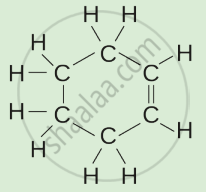 |
List two differences between the properties exhibited by covalent compounds and ionic compounds.
When ethyl alcohol and acetic acid are mixed, the resulting ester has a chemical formula ______.
Name the following:
\[\ce{CH3 - CH2CH = CH2}\]
Non-polar covalent compounds are ______ conductors of heat and electricity.
