Advertisements
Advertisements
प्रश्न
In forming oxygen molecule, ______ electrons are shared by each atom of oxygen.
Advertisements
उत्तर
In forming oxygen molecule, two electrons are shared by each atom of oxygen.
Explanation:
An oxygen atom has six valence electrons and needs two more to achieve a stable octet. When two oxygen atoms combine, each shares two of its own electrons with the other. This mutual sharing of four total electrons forms a stable covalent double bond (O = O).
APPEARS IN
संबंधित प्रश्न
Write structural formula of Methane.
State the reason to explain why covalent compounds "have low melting and boiling points."
Buckminsterfullerene is spherical molecule in which 60 carbon atoms are arranged in interlocking hexagonal and pentagonal rings of carbon atoms.
How many pentagons of carbon atoms are present in one molecule of buckminsterfullerene?
What type of bond is present in the following molecule?
Cl2
Which inert gas electron configuration do the Cl atoms in Cl2 molecule resemble? What is this electron configuration?
Give one example of the following:
A molecule containing a double covalent bond.
What is buckminsterfullerene?
Why is diamond used for making cutting tools (like glass cutters) but graphite is not?
How will you find out which of the water soluble compound A or B is ionic?
Describe the structure of diamond. Draw a s imple diagram to show the arrangement of carbon atoms in diamond.
Why are covalent compounds generally poor conductors of electricity?
Buckminsterfullerene is an allotropic form of the element:
The electronic configurations of two elements A and B are given below:
| A | 2, 6 |
| B | 2, 8, 1 |
- What type of chemical bond is formed between the two atoms of A?
- What type of chemical bond will be formed between the atoms of A and B?
Complete the following:
When the nuclei of two different reacting atoms are of ______ mass, then a bond so formed is called ______ covalent bond. (equal, unequal, polar, non-polar)
Draw all possible structural formulae of the compound from its molecular formula given below.
C4H10
Explain the following term with example.
Covalent bond
Give examples for the following:
Two liquid non polar compounds.
Explain the following:
Covalent compounds have low melting and boiling point.
Explain why carbon tetrachloride does not dissolve in water.
An element L consists of molecules.
- Which type of bond is present in the particles that make up L?
- When L is heated with iron metal, it forms a compound FeL. What chemical term would you use to describe change undergone by L?
An element L consists of molecules.
Why L is heated with iron metal, it forms a compound FeL. What chemical term would you use to describe the change undergone by L?
Electrons are getting added to an element Y.
- Is Y getting oxidized or reduced?
- Which electrode will Y migrate to during the process of electrolysis?
Element A has 2 electrons in its M shell. Element B has atomic number 7.
If the compound formed between A and B is melted and an electric current is passed through the molten compound, the element A will be obtained at the ______ and B at the ______ of the electrolytic cell.
What is the difference between a polar covalent compound and a non-polar covalent compound?
In the formation of electrovalent compounds, electrons are transferred from one element to another. How are electrons involved in the formation of a covalent compound?
Name the types of Hydrocarbons.
Number of valence electrons in a carbon atom is _______.
Complete the following activity.
Write the names of the hydrocarbons for the following structural formula.
(isobutylene, cyclohexane, propene, cyclohexene, cyclopentane, benzene, propyne, isobutane, propane)
| \[\begin{array}{cc} \phantom{.........}\ce{H}\\ \phantom{.........}|\\ \ce{H - C ≡ C - C - H}\\ \phantom{.........}|\\ \phantom{.........}\ce{H} \end{array}\] |
Complete the following activity.
Write the names of the hydrocarbons for the following structural formula.
(isobutylene, cyclohexane, propene, cyclohexene, cyclopentane, benzene, propyne, isobutane, propane)
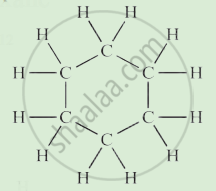 |
Give an example for each of the following statement.
A compound in which three covalent bonds are formed.
Identify the incorrect statement and correct them.
- Like covalent compounds, coordinate compounds also contain charged particles (ions). So they are good conductors of electricity.
- Ionic bond is a weak bond when compared to Hydrogen bond.
- Ionic or electrovalent bonds are formed by mutual sharing of electrons between atoms.
- Loss of electrons is called Oxidation and gain of electron is called Reduction.
- The electrons which are not involved in bonding are called valence electrons.
Which of the following is the purest form of carbon?
A molecule of ammonia (NH3) has
Oils on treating with hydrogen in the presence of palladium or nickel catalyst form fats. This is an example of
The table shows the electronic structures of four elements.
| Element | Electronic Structure |
| P | 2, 6 |
| Q | 2, 8, 1 |
| R | 2, 8, 7 |
| S | 2, 8, 8 |
- Identify which element(s) will form covalent bonds with carbon.
- “Carbon reacts with an element in the above table to form several compounds.” Give suitable reason.
______ is an example of a covalent compound having a high melting point.
Which of the following compound(s) possesses a high melting point?
Molecular reactions are ______ in the covalent compound.
In covalent compounds, the bond is formed due to ______ of electrons.
