Advertisements
Advertisements
Question
Give one example of the following:
A molecule containing a triple covalent bond.
Advertisements
Solution
A molecule containing a triple covalent bond is nitrogen.
APPEARS IN
RELATED QUESTIONS
List three characteristic properties of covalent compounds.
Elements forming ionic compounds attain noble gas configuration by either gaining or losing electrons from their outermost shells. Give reason to explain why carbon cannot attain noble gas configuration in this manner to form its compounds.
State the reason why carbon can neither form C4+ cations nor C4− anions but forms covalent compounds.
Explain the nature of the covalent bond using the bond formation in CH3Cl.
Choose the most appropriate answer from the following list of oxides which fit the description.
A covalent oxide of a metalloid.
Write any three features and give two examples of covalent compounds
Write the electron-dot structure for the following molecule:
Cl2
What type of bond is present in the following molecule?
CH4
What type of bond is present in the following molecule?
O2
Give one example of the following:
A molecule containing a single covalent bond.
Give one example of the following:
A molecule containing a double covalent bond.
What type of chemical bond is present in the chlorine molecule? Explain your answer.
Which inert gas does the Cl atom in HCl resemble in electron arrangement?
The organic compound prepared by Wohler from an inorganic compound called ammonium cyanate was ______.
One of the following is not an allotrope of carbon. This is:
Which of the following cannot exhibit isomerism?
An element E exists in three allotropic forms A, B and C. In allotrope A, the atoms of element E are joined to form spherical molecules. In allotrope B, each atom of element E is surrounded by three other E atoms to form a sheet like structure. În allotrope C, each atom of element E is surrounded by four other E atoms to form a rigid structure.
(a) Name the element E.
(b) What is allotrope A.
(c) What is allotrope B?
(d) What is allotrope C?
(e) Which allotrope is used in making jewellery?
(f) Which allotrope is used in making anode of a dry cell?
State the type of bonding in the following molecule.
Water
State the type of bonding in the following molecule.
Hydroxyl ion
Draw an electron dot diagram for the formation of the following. State the type of bonding present in them.
Hydroxyl ion
Give two example in following case:
Liquid non polar covalent compound.
Draw all possible structural formulae of the compound from its molecular formula given below.
C3H8
Draw electron - dot structure and structural formula of methane.
Give examples for the following:
Two liquid non polar compounds.
Choose the correct answer from the options given below
Which one is not example of polar covalent compound?
(a) Compound X consists of molecules.
Choose the letter corresponding to the correct answer from the choices (a), (b), (c) and (d) given below
In the liquid state, X will
Name a neutral covalent molecule which contains one lone pair of electrons.
Give a reason as to why hydrogen chloride can be termed as a polar covalent compound.
An element L consists of molecules.
- Which type of bond is present in the particles that make up L?
- When L is heated with iron metal, it forms a compound FeL. What chemical term would you use to describe change undergone by L?
An element L consists of molecules.
Why L is heated with iron metal, it forms a compound FeL. What chemical term would you use to describe the change undergone by L?
The particles present in strong electrolytes are
What do you understand by dipole (polar) molecule?
Potassium chloride is an electrovalent compound, while hydrogen chloride is a covalent compound, But, both conduct electricity in their aqueous solutions. Explain.
From the following hydrocarbon _______ is the cyclic hydrocarbon.
Your body is made up of carbon.
Explain covalent bond with example.
Complete the following activity.
Write the names of the hydrocarbons for the following structural formula.
(isobutylene, cyclohexane, propene, cyclohexene, cyclopentane, benzene, propyne, isobutane, propane)
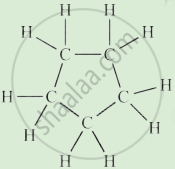 |
Name the following:
\[\ce{CH3 - CH2CH = CH2}\]
Explain dipole (polar) molecule by taking hydrogen chloride as an example.
