Advertisements
Advertisements
Question
(a) Compound X consists of molecules.
Choose the letter corresponding to the correct answer from the choices (a), (b), (c) and (d) given below
In the liquid state, X will
Options
become ionic
be an electrolyte
Conduct electricity
not conduct electricity
Advertisements
Solution
not conduct electricity
In the liquid state, X will: not conduct electricity
APPEARS IN
RELATED QUESTIONS
Buckminsterfullerene is spherical molecule in which 60 carbon atoms are arranged in interlocking hexagonal and pentagonal rings of carbon atoms.
How many pentagons of carbon atoms are present in one molecule of buckminsterfullerene?
State one use of diamond which depends on its ‘extraordinary brilliance’ and one use of graphite which depends on its being ‘black and quite soft’.
The number of covalent bonds in pentane (molecular formula C5H12) is ______.
An element A has 4 valence electrons in its atom whereas element B has only one valence electron in its atom. The compound formed by A and B does not conduct electricity. What is the nature of chemical bond in the compound formed? Give its electron-dot structure.
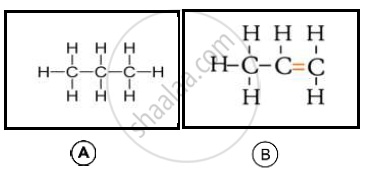
Observe the straight chain hydrocarbons given below and answer the following
questions :
i) Which of the straight chain compounds from A and B is saturated and unsaturated straight chains?
ii) Name these straight chains.
iii) Write their chemical formulae and number of – CH2 - units.
Name a neutral covalent molecule which contains one lone pair of electrons.
What is the difference between a polar covalent compound and a non-polar covalent compound?
Name gas with a rotten egg smell.
Non-polar covalent compounds are ______ conductors of heat and electricity.
