Advertisements
Advertisements
Question
What type of bonding would you expect between Carbon and Chlorine?
Advertisements
Solution
Carbon and chlorine react to form carbon tetrachloride (CCl4) by covalent bonding. Carbon contains four electrons in its outermost shell and chlorine contains seven electron in its outermost shell. So carbon shares electrons electrons with four chlorine atoms (one electron from each chlorine atom) to attain stability.
APPEARS IN
RELATED QUESTIONS
What type of bonds are present in CH4 molecule? Draw their electron-dot structures.
How will you find out which of the water soluble compound A or B is ionic?
The molecules having triple bond in them are:
(a) oxygen and ethyne
(b) carbon dioxide and ammonia
(c) methane and ethene
(d) nitrogen and ethyne
One of the following is not an allotrope of carbon. This is:
(a) diamond
(b) graphite
(c) cumene
(d) buckministerfullerene
Give the formulae of the chlorides of the elements X and Y having atomic numbers of 3 and 6 respectively. Will the properties of the two chlorides be similar or different? Explain your answer.
What happens when methane (natural gas) burns in air? Write the chemical equation of the reaction involved.
What is the difference between ionic compounds and covalent compounds?
State the type of bonding in the following molecule.
Water
State the type of bonding in the following molecule.
Methane
Explain the following:
Covalent compounds have low melting and boiling point.
State the type of bond formed when the combining atom has zero E.N. difference.
Explain the following:
Water is a polar covalent molecule.
Define the functional group and complete the following table.
| S.I. No. | Functional Group | Compound | Formula |
| (1) | ______________ | _______________ |
C2H5OH |
| (2) | _______________ | _______________ | CH3CHO |
Write scientific reason.
Carbon has the property of forming many compounds.
Complete the following activity.
Write the names of the hydrocarbons for the following structural formula.
(isobutylene, cyclohexane, propene, cyclohexene, cyclopentane, benzene, propyne, isobutane, propane)
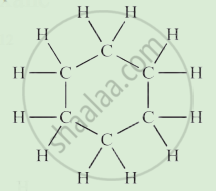 |
Considering MgCl2 as ionic compound and CH4 as covalent compound give any two differences between these two compounds.
Give an example for each of the following statement.
Formation of coordinate covalent bond between NH3 ➝ BF3 molecules
When ethyl alcohol and acetic acid are mixed, the resulting ester has a chemical formula ______.
Two carbon atoms can always form one or two covalent bonds.
Non-polar covalent compounds are ______ conductors of heat and electricity.
