Advertisements
Advertisements
प्रश्न
What type of bonding would you expect between Carbon and Chlorine?
Advertisements
उत्तर
Carbon and chlorine react to form carbon tetrachloride (CCl4) by covalent bonding. Carbon contains four electrons in its outermost shell and chlorine contains seven electron in its outermost shell. So carbon shares electrons electrons with four chlorine atoms (one electron from each chlorine atom) to attain stability.
APPEARS IN
संबंधित प्रश्न
State the reason to explain why covalent compounds "have low melting and boiling points."
Buckminsterfullerene is spherical molecule in which 60 carbon atoms are arranged in interlocking hexagonal and pentagonal rings of carbon atoms.
How many pentagons of carbon atoms are present in one molecule of buckminsterfullerene?
Fill in the blanks in the following sentence:
In forming oxygen molecule, .............. electrons are shared by each atom of oxygen.
Fill in the following blank with suitable word:
The general formula CnH2n for cycloalkanes is the same as that of ...........
What type of chemical bond is present in chlorine molecule? Explain your answer.
Explain the formation of a chlorine molecule on the basis of electronic theory of valency.
Explain why, ionic compounds conduct electricity in solution whereas covalent compounds do not conduct electricity.
The number of covalent bonds in pentane (molecular formula C5H12) is:
Which of the following cannot exhibit isomerism?
(a) C4H10
(b) C5H12
(c) C3H8
(d) C6H14
The number of isomers formed by the hydrocarbon with molecular formula C5H12 is:
(a) 2
(b) 5
(c) 3
(d) 4
Define a covalent bond.
State the type of bonding in the following molecule.
Water
Explain the following briefly:
Sodium chloride dissolves in water but carbon tetra chloride is insoluble in water.
Give examples for the following:
Two gaseous polar compounds.
Explain the structure of Ammonium ion.
Fill in the blank with correct word from the bracket.
Melting and boiling points of covalent compounds are generally ______ (low, high).
Draw the electron dot diagram and structure of magnesium chloride.
Name gas with a rotten egg smell.
Complete the following activity.
Write the names of the hydrocarbons for the following structural formula.
(isobutylene, cyclohexane, propene, cyclohexene, cyclopentane, benzene, propyne, isobutane, propane)
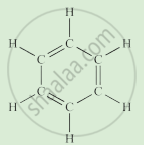 |
Which of the following are correct structural isomers of butane?
- \[\begin{array}{cc}
\ce{H}\phantom{...}\ce{H}\phantom{...}\ce{H}\phantom{...}\ce{H}\\
|\phantom{....}|\phantom{....}|\phantom{....}|\\
\ce{H - C - C - C - C - H}\\
|\phantom{....}|\phantom{....}|\phantom{....}|\\
\ce{H}\phantom{...}\ce{H}\phantom{...}\ce{H}\phantom{...}\ce{H}\\
\end{array}\] - \[\begin{array}{cc}
\ce{H}\phantom{...}\ce{H}\phantom{...}\ce{H}\\
|\phantom{....}|\phantom{....}|\\
\ce{H - C - C - C - H}\\
|\phantom{.....}|\phantom{.....}|\\
\ce{H}\ce{H-C-H}\ce{H}\\
|\\
\ce{H}\\
\end{array}\] - \[\begin{array}{cc}
\ce{H}\phantom{...}\ce{H}\phantom{...}\ce{H}\\
|\phantom{....}|\phantom{....}|\\
\ce{H - C - C - C - H}\\
|\phantom{.....}\backslash\phantom{..}|\\
\phantom{....}\ce{H}\phantom{......}\ce{C - H}\phantom{}\\
\phantom{.......}|\\
\phantom{.......}\ce{H}\\
\end{array}\] - \[\begin{array}{cc}
\ce{H}\phantom{...}\ce{H}\\
|\phantom{....}|\\
\ce{H - C - C - H}\\
|\phantom{....}|\\
\ce{H - C - C - H}\\
|\phantom{....}|\\
\ce{H}\phantom{...}\ce{H}\\
\end{array}\]
