Advertisements
Advertisements
प्रश्न
What type of bonding would you expect between Carbon and Chlorine?
Advertisements
उत्तर
Carbon and chlorine react to form carbon tetrachloride (CCl4) by covalent bonding. Carbon contains four electrons in its outermost shell and chlorine contains seven electron in its outermost shell. So carbon shares electrons electrons with four chlorine atoms (one electron from each chlorine atom) to attain stability.
APPEARS IN
संबंधित प्रश्न
Why are most carbon compounds poor conductors of electricity?
Name a carbon containing molecule which has two double bonds.
What type of bonds are present in H2 molecule? Draw their electron-dot structures.
What type of bonds are present in Cl2 molecule? Draw their electron-dot structures.
Fill in the blank in the following sentence:
Two atoms of the same element combine to form a molecule. The bond between them is known as ................ bond.
What is buckminsterfullerene?
Using electron-dot diagrams which show only the outermost shell electrons, show how a molecule of nitrogen, N2, is formed from two nitrogen atoms. What name is given to this type of bonding? (Atomic number of nitrogen is 7)
Draw the electron-dot structure of CO2 compound and state the type of bonding.
Explain why, diamond is hard while graphite is soft (though both are made of carbon atoms).
Why is graphite a good conductor of electricity but diamond is a non-conductor of electricity?
Explain the following term with example.
Alkane
Draw electron - dot structure and structural formula of methane.
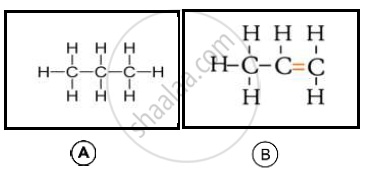
Observe the straight chain hydrocarbons given below and answer the following
questions :
i) Which of the straight chain compounds from A and B is saturated and unsaturated straight chains?
ii) Name these straight chains.
iii) Write their chemical formulae and number of – CH2 - units.
The carbon compound is used in daily life is ______.
Compound X consists of molecules.
Choose the letter corresponding to the correct answer from the options A, B, C and D given below:
X is likely to have a ______.
Elements Q and S react together to form an ionic compound. Under normal conditions, which physical state will the compound QS exist in?
Covalent bonds can be single, double or triple covalent bonds. How many electrons are shared in each? Give an example of each type.
Cation is formed when ______.
`"CH"_3 - "CH"_2 - "OH" overset("Alkaline""KMnO"_4 + "Heat")(->) "CH"_3 - "COOH"`
In the above given reaction, alkaline KMnO4 acts as
Mineral acids are stronger acids than carboxylic acids because
- mineral acids are completely ionised
- carboxylic acids are completely ionised
- mineral acids are partially ionised
- carboxylic acids are partially ionised
