What do you call the compounds having the same molecular formula but different structural arrangements of atoms?
Advertisements
Question
What do you call the compounds having the same molecular formula but different structural arrangements of atoms?
Advertisements
Solution
Isomers are the forms of compounds with the same molecular formula but different structural arrangements of atoms.
APPEARS IN
RELATED QUESTIONS
Elements forming ionic compounds attain noble gas configuration by either gaining or losing electrons from their outermost shells. Give reason to explain why carbon cannot attain noble gas configuration in this manner to form its compounds.
What would be the electron dot structure of a molecule of sulphur which is made up of eight atoms of sulphur? (Hint – the eight atoms of sulphur are joined together in the form of a ring.)
Choose the most appropriate answer from the following list of oxides which fit the description.
A covalent oxide of a metalloid.
What type of bonds are present in a water molecule?
Give one example of the following:
A molecule containing a single covalent bond.
What type of chemical bonds are formed by carbon? Why?
Explain why, ionic compounds conduct electricity in solution whereas covalent compounds do not conduct electricity.
will CS2 conduct electricity or not?
give reason for your choice.
Draw the electron-dot structure of the following compound and state the type of bonding in the given case:
CO2
State one use of diamond which depends on its ‘extraordinary brilliance’ and one use of graphite which depends on its being ‘black and quite soft’.
The solution of one of the following compounds will not conduct electricity. This compound is:
One of the following contains a double bond as well as single bonds. This is:
The organic compound prepared by Wohler from an inorganic compound called ammonium cyanate was ______.
Give the formulae of the chlorides of the elements X and Y having atomic numbers of 3 and 6 respectively. Will the properties of the two chlorides be similar or different? Explain your answer.
Define a covalent bond.
Draw an electron dot structure of the following molecule. (Without showing the circle) :
Methanol
Write answer as directed.
What causes the existance of very large number of carbon compound ?
Write answer as directed.
Saturated hydrocarbons are classified into three types. Write these names giving one example each.
Explain the following briefly:
Cl2 is a non polar molecule, while HCl is a polar molecule.
Give examples for the following:
Two liquid non polar compounds.
(a) Compound X consists of molecules.
Choose the letter corresponding to the correct answer from the choices (a), (b), (c) and (d) given below
The type of bonding in X will be
The electronic configuration of N2 is 2, 5. How many electrons in the outer shell of a N atom are not involved in the formation of a nitrogen molecule?
An element L consists of molecules.
Why L is heated with iron metal, it forms a compound FeL. What chemical term would you use to describe the change undergone by L?
Which of the following is a common characteristic of a covalent compound?
Compound X consists of molecules.
Choose the letter corresponding to the correct answer from the options A, B, C and D given below:
X is likely to have a ______.
Explain why carbon tetrachloride does not dissolve in water.
Draw the electron dot diagram and structure of methane.
State the type of bond formed, and draw Lewis structure of water.
Element A has 2 electrons in its M shell. Element B has atomic number 7.
- Write equations to show how A and B form ions.
- If B is a diatomic gas, write the equation for the direct combination of A and B to form a compound.
- If the compound formed between A and B is melted and an electric current is passed through the molten compound, the element A will be obtained at the ______ and B at the ______ of the electrolytic cell.
What is the difference between a polar covalent compound and a non-polar covalent compound?
Taking MgCl2 as an electrovalent compound, CCl4 as a covalent compound, give four difference between electrovalent and covalent compounds
Give an example of the covalent bond formed by
(i) Similar atoms (ii) Dissimilar atoms
Name a greenish-yellow gas which also bleaches.
What are Allotropes? Name any two allotropic forms of carbon. Give one use of it.
Write an Explanation.
Alkane
Write an Explanation.
Alkene
Complete the following activity.
Write the names of the hydrocarbons for the following structural formula.
(isobutylene, cyclohexane, propene, cyclohexene, cyclopentane, benzene, propyne, isobutane, propane)
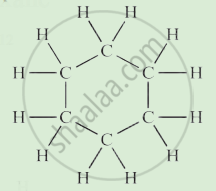 |
Which of the following is the purest form of carbon?
Cation is formed when ______.
In covalent compounds, the bond is formed due to ______ of electrons.
