The form of carbon which is known as black lead is ______.
Advertisements
Question
The form of carbon which is known as black lead is ______.
Advertisements
Solution
The form of carbon which is known as black lead is graphite.
APPEARS IN
RELATED QUESTIONS
State the reason why carbon can neither form C4+ cations nor C4− anions but forms covalent compounds.
State the reason to explain why covalent compounds "have low melting and boiling points."
Choose the correct answer from the options given below:
Which of the following is a common characteristic of a covalent compound?
1) high melting point
2) consists of molecules
3) always soluble in water
4) Conducts electricity when it is in the molten state
Choose the most appropriate answer from the following list of oxides which fit the description.
A covalent oxide of a metalloid.
Name the following:
The property of element by virtue of which atoms of the element can link to each other in the form of a long chain or ring structure.
State whether the following statement is true or false:
Diamond and graphite are the covalent compounds of carbon element (C).
What type of chemical bond is formed between:
Carbon and bromine
What is buckminsterfullerene?
will CS2 conduct electricity or not?
give reason for your choice.
Draw the electron-dot structure of the following compound and state the type of bonding in the given case:
N2
Write two points of difference in the structures of diamond and graphite.
Explain why, diamond can be used in rock drilling equipment but graphite cannot.
State one use of diamond which depends on its ‘extraordinary brilliance’ and one use of graphite which depends on its being ‘black and quite soft’.
Of what substance is graphite made?
The pencil leads are made of mainly ______.
Complete the following:
When the nuclei of two different reacting atoms are of ______ mass, then a bond so formed is called ______ covalent bond. (equal, unequal, polar, non-polar)
Draw all possible structural formulae of the compound from its molecular formula given below.
C3H4
Explain the following term with example.
Alkane
Write answer as directed.
Saturated hydrocarbons are classified into three types. Write these names giving one example each.
Explain the following briefly.
Pure water does not conduct electricity, but on adding sodium chloride to it, it starts conducting electricity.
Explain the following:
Covalent compounds are generally gases or liquids or soft solids.
(a) Compound X consists of molecules.
Choose the letter corresponding to the correct answer from the choices (a), (b), (c) and (d) given below
X is likely to have a :
The molecule which contains a triple covalent bond is ______.
Draw the electron dot diagram and structure of nitrogen molecule.
Element A has 2 electrons in its M shell. Element B has atomic number 7.
If the compound formed between A and B is melted and an electric current is passed through the molten compound, the element A will be obtained at the ______ and B at the ______ of the electrolytic cell.
Potassium chloride is an electrovalent compound, while hydrogen chloride is a covalent compound, But, both conduct electricity in their aqueous solutions. Explain.
Define the functional group and complete the following table.
| S.I. No. | Functional Group | Compound | Formula |
| (1) | ______________ | _______________ |
C2H5OH |
| (2) | _______________ | _______________ | CH3CHO |
Number of valence electrons in a carbon atom is _______.
Write a short note.
Characteristics of carbon
Complete the following activity.
Write the names of the hydrocarbons for the following structural formula.
(isobutylene, cyclohexane, propene, cyclohexene, cyclopentane, benzene, propyne, isobutane, propane)
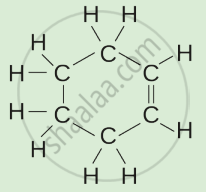 |
The number of pi-bonds present in benzoic acid molecule are ______.
Acetic acid was added to a solid X kept in a test tube. A colourless, odourless gas Y was evolved. The gas was passed through lime water, which turned milky. It was concluded that ______.
Which of the following are correct structural isomers of butane?
- \[\begin{array}{cc}
\ce{H}\phantom{...}\ce{H}\phantom{...}\ce{H}\phantom{...}\ce{H}\\
|\phantom{....}|\phantom{....}|\phantom{....}|\\
\ce{H - C - C - C - C - H}\\
|\phantom{....}|\phantom{....}|\phantom{....}|\\
\ce{H}\phantom{...}\ce{H}\phantom{...}\ce{H}\phantom{...}\ce{H}\\
\end{array}\] - \[\begin{array}{cc}
\ce{H}\phantom{...}\ce{H}\phantom{...}\ce{H}\\
|\phantom{....}|\phantom{....}|\\
\ce{H - C - C - C - H}\\
|\phantom{.....}|\phantom{.....}|\\
\ce{H}\ce{H-C-H}\ce{H}\\
|\\
\ce{H}\\
\end{array}\] - \[\begin{array}{cc}
\ce{H}\phantom{...}\ce{H}\phantom{...}\ce{H}\\
|\phantom{....}|\phantom{....}|\\
\ce{H - C - C - C - H}\\
|\phantom{.....}\backslash\phantom{..}|\\
\phantom{....}\ce{H}\phantom{......}\ce{C - H}\phantom{}\\
\phantom{.......}|\\
\phantom{.......}\ce{H}\\
\end{array}\] - \[\begin{array}{cc}
\ce{H}\phantom{...}\ce{H}\\
|\phantom{....}|\\
\ce{H - C - C - H}\\
|\phantom{....}|\\
\ce{H - C - C - H}\\
|\phantom{....}|\\
\ce{H}\phantom{...}\ce{H}\\
\end{array}\]
`"CH"_3 - "CH"_2 - "OH" overset("Alkaline""KMnO"_4 + "Heat")(->) "CH"_3 - "COOH"`
In the above given reaction, alkaline KMnO4 acts as
The table shows the electronic structures of four elements.
| Element | Electronic Structure |
| P | 2, 6 |
| Q | 2, 8, 1 |
| R | 2, 8, 7 |
| S | 2, 8, 8 |
- Identify which element(s) will form covalent bonds with carbon.
- “Carbon reacts with an element in the above table to form several compounds.” Give suitable reason.
Which of the following compound(s) possesses a high melting point?
Molecular reactions are ______ in the covalent compound.
