The general formula CnH2n for cycloalkanes is the same as that of ______.
Advertisements
Question
The general formula CnH2n for cycloalkanes is the same as that of ______.
Advertisements
Solution
The general formula CnH2n for cycloalkanes is the same as that of alkenes.
APPEARS IN
RELATED QUESTIONS
Ethane, with the molecular formula C2H6 has ______.
Explain the nature of the covalent bond using the bond formation in CH3Cl.
What type of bond is present in the following molecule?
Cl2
Give one example of the following:
A molecule containing a double covalent bond.
Two atoms of the same element combine to form a molecule. The bond between them is known as ______ bond.
What type of chemical bond is present in the chlorine molecule? Explain your answer.
Giving one example, state what are covalent compounds.
Explain why, diamond is hard while graphite is soft (though both are made of carbon atoms).
State any two uses of diamond.
The solution of one of the following compounds will not conduct electricity. This compound is:
One of the following compounds is not ionic in nature. This compound is:
Which of the following has a triple bond as well as single bonds?
The electronic configurations of three elements X, Y and Z are as follows:
| X | 2, 4 |
| Y | 2, 7 |
| Z | 2, 1 |
- Which two elements will combine to form an ionic compound?
- Which two elements will react to form a covalent compound?
Give reasons for your choice.
The electronic configurations of two elements A and B are given below:
| A | 2, 6 |
| B | 2, 8, 1 |
- What type of chemical bond is formed between the two atoms of A?
- What type of chemical bond will be formed between the atoms of A and B?
What are the conditions necessary for the formation of covalent molecules?
Give the characteristic properties of covalent compounds.
State the type of bonding in the following molecule.
Ammonium ion
Which element exhibits the property of catenation to maximum extent and why?
Draw an electron dot structure of the following molecule. (Without showing the circle) :
Water
Draw all possible structural formulae of the compound from its molecular formula given below.
C3H4
The following structural formula belongs to which carbon compound?
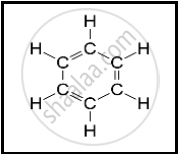
Acids dissolve in water to produce positively charged ions. Draw the structure of these positive ions.
State the type of bonding in the following molecule.
Water
Elements Q and S react together to form an ionic compound. Under normal conditions, which physical state will the compound QS exist in?
What is the difference between :
Ionic compounds and covalent compounds
Taking MgCl2 as an electrovalent compound, CCl4 as a covalent compound, give four difference between electrovalent and covalent compounds
Potassium chloride is an electrovalent compound, while hydrogen chloride is a covalent compound, But, both conduct electricity in their aqueous solutions. Explain.
In the formation of electrovalent compounds, electrons are transferred from one element to another. How are electrons involved in the formation of a covalent compound?
Name the types of Hydrocarbons.
Write the molecular formula of the given compound.
Propylene
Write a short note.
Characteristics of carbon
Complete the following activity.
Write the names of the hydrocarbons for the following structural formula.
(isobutylene, cyclohexane, propene, cyclohexene, cyclopentane, benzene, propyne, isobutane, propane)
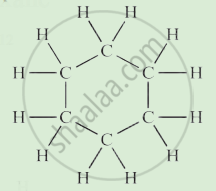 |
Considering MgCl2 as ionic compound and CH4 as covalent compound give any two differences between these two compounds.
Give an example for each of the following statement.
A compound in which three covalent bonds are formed.
Two carbon atoms can always form one or two covalent bonds.
The table shows the electronic structures of four elements.
| Element | Electronic Structure |
| P | 2, 6 |
| Q | 2, 8, 1 |
| R | 2, 8, 7 |
| S | 2, 8, 8 |
- Identify which element(s) will form covalent bonds with carbon.
- “Carbon reacts with an element in the above table to form several compounds.” Give suitable reason.
______ is an example of a covalent compound having a high melting point.
Molecular reactions are ______ in the covalent compound.
The electron dot structure of chlorine molecule is:
