Advertisements
Advertisements
Question
The electronic configurations of three elements X, Y and Z are as follows:
| X | 2, 4 |
| Y | 2, 7 |
| Z | 2, 1 |
- Which two elements will combine to form an ionic compound?
- Which two elements will react to form a covalent compound?
Give reasons for your choice.
Advertisements
Solution
- Elements Y and Z combine to form an ionic compound by transfer of one electron from Z to Y.
- Elements X and Y will react to form a covalent compound because atom X can react with 4 atoms of Y to share one electron.
APPEARS IN
RELATED QUESTIONS
List three characteristic properties of covalent compounds.
Name the type of bonds formed in ionic compounds and in the compounds formed by carbon.
Choose the correct answer from the options given below:
Which of the following is a common characteristic of a covalent compound?
1) high melting point
2) consists of molecules
3) always soluble in water
4) Conducts electricity when it is in the molten state
An element L consists of molecules.
What type of bonding is present in the particles that make up L?
Name a carbon containing molecule which has two double bonds.
What type of bond is present in the following molecule?
Cl2
In forming oxygen molecule, ______ electrons are shared by each atom of oxygen.
What type of bond exists in CCl4?
What type of chemical bonds are formed by carbon? Why?
Explain why:
Covalent compounds have generally low melting points.
Give two general properties of ionic compounds.
will CS2 conduct electricity or not?
give reason for your choice.
Draw the electron-dot structure of the following compound and state the type of bonding in the given case:
CO2
Explain why, diamond has a high melting point.
State any two uses of diamond.
One of the following compounds is not ionic in nature. This compound is:
The pencil leads are made of mainly ______.
What are the conditions necessary for the formation of covalent molecules?
State the type of bonding in the following molecule.
Hydroxyl ion
State the type of bonding in the following molecule.
Methane
Complete the following:
In case of non-polar covalent bond, the covalent bond is formed in the ______ of atoms and shared electrons are ______ distributed. (corner, middle, equally, unequally)
Draw an electron dot structure of the following molecule. (Without showing the circle) :
Methane
Explain the following term with example.
Covalent bond
Explain the following term with example.
Hetero atom in a carbon compound
The following structural formula belongs to which carbon compound?
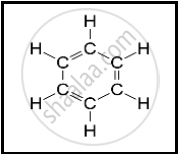
In the formation of electrovalent compounds, electrons are transferred from one element to another. How are electrons involved in the formation of a covalent compound?
Compare the compounds carbon tetrachloride and sodium chloride with regard to solubility in water and electrical conductivity.
What are the term defined below?
A bond formed by share pair of electrons, each bonding atom contributing one electron to the pair.
Draw the electron dot diagram and structure of methane.
Element A has 2 electrons in its M shell. Element B has atomic number 7.
If B is a diatomic gas, write the equation for the direct combination of A and B to form a compound.
Taking MgCl2 as an electrovalent compound, CCl4 as a covalent compound, give four difference between electrovalent and covalent compounds
Give an example of the covalent bond formed by
(i) Similar atoms (ii) Dissimilar atoms
Complete the following activity.
Write the names of the hydrocarbons for the following structural formula.
(isobutylene, cyclohexane, propene, cyclohexene, cyclopentane, benzene, propyne, isobutane, propane)
| \[\begin{array}{cc} \phantom{..}\ce{H}\phantom{...}\ce{H}\phantom{...}\ce{H}\\ \phantom{..}|\phantom{....}|\phantom{....}|\\ \ce{H - C - C- C- H}\\ \phantom{.}|\phantom{....}|\phantom{....}|\\ \ce{H - C - H}\\ |\\\ce{H}\end{array}\] |
Give an example for each of the following statement.
A compound in which three covalent bonds are formed.
Identify the incorrect statement and correct them.
- Like covalent compounds, coordinate compounds also contain charged particles (ions). So they are good conductors of electricity.
- Ionic bond is a weak bond when compared to Hydrogen bond.
- Ionic or electrovalent bonds are formed by mutual sharing of electrons between atoms.
- Loss of electrons is called Oxidation and gain of electron is called Reduction.
- The electrons which are not involved in bonding are called valence electrons.
Which of the following statements are correct for carbon compounds?
- Most carbon compounds are good conductors of electricity.
- Most carbon compounds are poor conductors of electricity.
- Force of attraction between molecules of carbon compounds is not very strong.
- Force of attraction between molecules of carbon compounds is very strong.
State the reasons, why carbon cannot
- Lose four electrons to form C4+ cation and
- Gain four electrons to form C4- anion.
How does carbon overcome this problem to form compounds?
Carbon can neither form C4- cation nor C4 anion. Why?
