Advertisements
Advertisements
Questions
What does ‘competent’ refer to in competent cells used in transformation experiments?
What does ‘competent’ refer to in competent cells used in transformation?
Advertisements
Solution
Competent means bacterial cells, on treatment with CaCl₂, are made capable of taking up foreign DNA.
APPEARS IN
RELATED QUESTIONS
Draw a schematic sketch of pBR 322 plasmid and label the following in it:
(a) Any two restriction sites.
(b) Ori and rop genes.
(c) An antibiotic resistant gene.
Describe briefly the following:
Origin of replication
Why is the coding sequence of an enzyme β-galactosidase a preferred selectable marker in comparison to the ones named above?
Write the role of ‘restriction sites’ in the cloning vector pBR322.
Explain the importance of ‘Selectable marker’, with the help of a suitable example.
Answer the following question.
β galactosidase enzyme is considered a better selectable marker. Justify the statement.
The colonies of recombinant bacteria appear white in contrast to blue colonies of non-recombinant bacteria because of ______.
Which of the following is correctly matched?
Which of the following statement is not true for a clone?
A suitable vector for gene cloning in higher organism is ______.
Plasmids are suitable vectors for gene cloning because these ______.
A cloning vector should possess which of the following characters?
- Origin of replication (Ori)
- Ability to destroy the alien DNA
- Cloning site to link the alien DNA
- The tumour inducing plasmid Ti.
- Selectable marker.
- Low molecular weight
The CORRECT combination is
Describe the role of Agrobacterium tumefaciens in transforming a plant cell.
The figure below shows the structure of a plasmid.
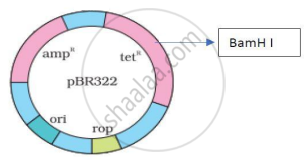
A foreign DNA was ligated at BamH1. The transformants were then grown in a medium containing antibiotics tetracycline and ampicillin.
Choose the correct observation for the growth of bacterial colonies from the given table.
The following diagram showing restriction sites in E. coli cloning vector pBR322. Find the role of ‘X’ and ‘Y’ genes:
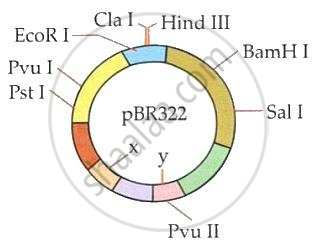
Which of the following is not a cloning vector?
What is the primary function of a vector in recombinant DNA technology?
Which of the following serves as an example of selectable markers commonly found in plasmid vectors like pBR322?
