Advertisements
Advertisements
Question
Can you think and answer how a reporter enzyme can be used to monitor the transformation of host cells by foreign DNA in addition to a selectable marker?
Advertisements
Solution
Transformation is the process of introducing a fragment of DNA into a host bacterial cell. Normally, genes encoding antibiotic resistance, such as ampicillin and tetracycline, are considered useful selection markers for discriminating between transformed and non-transformed bacterial cells. In addition to these selectable markers, another selectable marker has been designed to distinguish between transformed and non-transformed bacterial cells based on their ability to produce colour in the presence of a chromogenic material. A recombinant DNA is inserted into the coding sequence of β-galactosidase, a reporter enzyme. If the plasmid in the bacterium does not have an insert, the presence of a chromogenic substance gives blue-coloured colonies. The presence of an insert results in insertional inactivation of β-galactosidase and, therefore, the colonies do not produce any colour. These colonies are marked as transformed.
APPEARS IN
RELATED QUESTIONS
Describe briefly the following:
Origin of replication
Explain the importance of ‘Selectable marker’, with the help of a suitable example.
A clone is a ______.
Which of the following statement is not true for a clone?
A suitable vector for gene cloning in higher organism is ______.
Plasmids are suitable vectors for gene cloning because these ______.
Which of the following is not a genetic vector?
A cloning vector should possess which of the following characters?
- Origin of replication (Ori)
- Ability to destroy the alien DNA
- Cloning site to link the alien DNA
- The tumour inducing plasmid Ti.
- Selectable marker.
- Low molecular weight
The CORRECT combination is
Which of the following is not a cloning vector?
What modification is done on the Ti plasmid of Agrobacterium tumefaciens to convert it into a cloning vector?
A plasmid without a selectable marker was chosen as vector for cloning a gene. How does this affect the experiment?
Name the regions marked A, B and C.

For selection of recombinants, insertional inactivation of antibiotic marker has been superceded by insertional inactivation of a marker gene coding for a chromogenic substrate. Give reasons.
The figure below shows the structure of a plasmid.
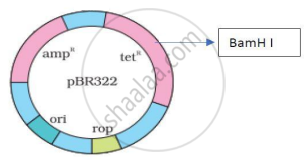
A foreign DNA was ligated at BamH1. The transformants were then grown in a medium containing antibiotics tetracycline and ampicillin.
Choose the correct observation for the growth of bacterial colonies from the given table.
Which of the following is not a cloning vector?
In blue–white screening, what do the white colonies indicate?
Which vector derived from \(\textit{Agrobacterium tumefaciens}\) is utilized for delivering foreign genes into plants?
Which of the following is a group of vectors used for gene transfer into animals?
