Advertisements
Advertisements
Question
Name the selectable markers in the cloning vector pBR322. Mention the role they play.
Advertisements
Solution 1
In the cloning vector pBR322, ampicillin and tetracycline resistance genes serve as selectable markers. They help in the selection of transformed cells from nontransformed cells. They also help distinguish recombinant cells from nonrecombinant cells.
Solution 2
The selectable markers in the cloning vector pBR322 are the genes encoding resistance to antibiotics, specifically ampicillin and tetracycline. These markers play a crucial role in identifying and selecting transformants. When a foreign DNA is inserted into the vector, it disrupts one of the antibiotic resistance genes, often the tetracycline resistance gene. This results in transformants that are resistant to ampicillin but sensitive to tetracycline, allowing selection of recombinant cells. The markers enable growth of only those bacteria that have taken up the plasmid and help distinguish recombinants from non-recombinants through antibiotic sensitivity patterns.
RELATED QUESTIONS
Describe briefly the following:
Origin of replication
Why is the coding sequence of an enzyme β-galactosidase a preferred selectable marker in comparison to the ones named above?
Answer the following question.
β galactosidase enzyme is considered a better selectable marker. Justify the statement.
The colonies of recombinant bacteria appear white in contrast to blue colonies of non-recombinant bacteria because of ______.
A suitable vector for gene cloning in higher organism is ______.
A plasmid without a selectable marker was chosen as vector for cloning a gene. How does this affect the experiment?
For selection of recombinants, insertional inactivation of antibiotic marker has been superceded by insertional inactivation of a marker gene coding for a chromogenic substrate. Give reasons.
The figure below shows the structure of a plasmid.
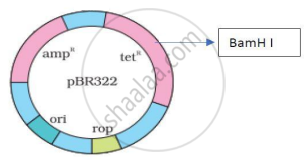
A foreign DNA was ligated at BamH1. The transformants were then grown in a medium containing antibiotics tetracycline and ampicillin.
Choose the correct observation for the growth of bacterial colonies from the given table.
Which of the following enzyme(s) are NOT essential for gene cloning?
- Restriction enzymes
- DNA ligase
- DNA mutase
- DNA recombinase
- DNA polymerase
Choose the correct answer from the options given below:
Which of the following is not a cloning vector?
