Advertisements
Advertisements
Question
For selection of recombinants, insertional inactivation of antibiotic marker has been superceded by insertional inactivation of a marker gene coding for a chromogenic substrate. Give reasons.
Advertisements
Solution
Selection of recombinants due to the inactivation of antibiotics is a laborious process as it requires:
- A vector with two antibiotic resistance marker
- Preparation of two kinds of media plate, with one antibiotic each.
Transformed cells are first plated on that antibiotic plate which has not been intentionally inactivated (ampicillin) and incubated overnight for the growth of transformants. For the selection of recombinants, these transformants are Replica plated on a second antibiotic (tetracycline) plate (which got inactivated due to insertion of the gene). Non-Recombinants grow on both plates (one carrying ampicillin and the other carrying tetracycline ) while recombinants will grow only on the ampicillin plate.
This entire exercise is laborious and takes more time (two overnight incubation). However, if we choose the second option (insertional inactivation of a marker that produces colour in the presence of a chromogenic compound), we can distinguish between the recombinants and non-recombinants on a single medium plate (containing one antibiotic and the chromogenic compound) after overnight growth.
Hence I would choose a marker which produces a coloured compound but gets inactivated due to the insertion of foreign DNA.
APPEARS IN
RELATED QUESTIONS
State how has Agrobacterium tumifaciens been made a useful cloning vector to transfer DNA to plant cells.
What is ‘Ori’ ? State its importance during cloning of a vector.
How does the β-galactosidase coding sequence act as a selectable marker? Why is it a preferred selectable marker to antibiotic resistance genes? Explain.
The genetic material of virus includes:
A clone is a ______.
Plasmids are suitable vectors for gene cloning because these ______.
Which of the following is not a cloning vector?
Plasmid pBR322 has a PstI restriction enzyme site within gene ampR that confers ampicillin resistance. If this enzyme is used for inserting a gene for β-galactoside production and the recombinant plasmid is inserted in an E.coli strain.
Name the regions marked A, B and C.

Describe the role of Agrobacterium tumefaciens in transforming a plant cell.
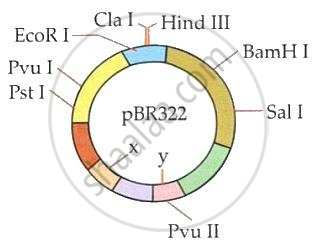
The following diagram showing restriction sites in E. coli cloning vector pBR322. Find the role of ‘X’ and ‘Y’ genes:
The “Ti plasmid” of Agrobacterium tumefaciens stands for ______.
Which of the following is not a cloning vector?
What is the primary function of a vector in recombinant DNA technology?
What is the basic biological nature of plasmids when used as cloning vectors?
Which of the following describes the function of a selectable marker in a cloning vector?
Which of the following serves as an example of selectable markers commonly found in plasmid vectors like pBR322?
What is the primary role of a cloning site in a vector?
