Advertisements
Advertisements
Question
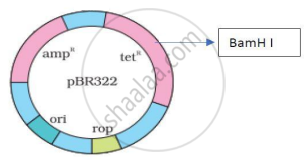
Name the regions marked A, B and C.

Advertisements
Solution
A - Bam HI
B - Pst I
C - Ampicillin resistance gene (ampR)
APPEARS IN
RELATED QUESTIONS
Draw a schematic sketch of pBR 322 plasmid and label the following in it:
(a) Any two restriction sites.
(b) Ori and rop genes.
(c) An antibiotic resistant gene.
Can you think and answer how a reporter enzyme can be used to monitor the transformation of host cells by foreign DNA in addition to a selectable marker?
Write the role of ‘restriction sites’ in the cloning vector pBR322.
Answer the following question.
β galactosidase enzyme is considered a better selectable marker. Justify the statement.
A clone is a ______.
Which of the following is not a genetic vector?
Which of the following is not a cloning vector?
Plasmid pBR322 has a PstI restriction enzyme site within gene ampR that confers ampicillin resistance. If this enzyme is used for inserting a gene for β-galactoside production and the recombinant plasmid is inserted in an E.coli strain.
What does ‘competent’ refer to in competent cells used in transformation experiments?
What modification is done on the Ti plasmid of Agrobacterium tumefaciens to convert it into a cloning vector?
A plasmid without a selectable marker was chosen as vector for cloning a gene. How does this affect the experiment?
The figure below shows the structure of a plasmid.
A foreign DNA was ligated at BamH1. The transformants were then grown in a medium containing antibiotics tetracycline and ampicillin.
Choose the correct observation for the growth of bacterial colonies from the given table.
Which of the following describes the function of a selectable marker in a cloning vector?
Which of the following serves as an example of selectable markers commonly found in plasmid vectors like pBR322?
What is the primary role of a cloning site in a vector?
Which vector derived from \(\textit{Agrobacterium tumefaciens}\) is utilized for delivering foreign genes into plants?
Which of the following is a group of vectors used for gene transfer into animals?
