Advertisements
Advertisements
प्रश्न
Can you think and answer how a reporter enzyme can be used to monitor the transformation of host cells by foreign DNA in addition to a selectable marker?
Advertisements
उत्तर
Transformation is the process of introducing a fragment of DNA into a host bacterial cell. Normally, genes encoding antibiotic resistance, such as ampicillin and tetracycline, are considered useful selection markers for discriminating between transformed and non-transformed bacterial cells. In addition to these selectable markers, another selectable marker has been designed to distinguish between transformed and non-transformed bacterial cells based on their ability to produce colour in the presence of a chromogenic material. A recombinant DNA is inserted into the coding sequence of β-galactosidase, a reporter enzyme. If the plasmid in the bacterium does not have an insert, the presence of a chromogenic substance gives blue-coloured colonies. The presence of an insert results in insertional inactivation of β-galactosidase and, therefore, the colonies do not produce any colour. These colonies are marked as transformed.
APPEARS IN
संबंधित प्रश्न
State how has Agrobacterium tumifaciens been made a useful cloning vector to transfer DNA to plant cells.
Describe briefly the following:
Origin of replication
Why is the coding sequence of an enzyme β-galactosidase a preferred selectable marker in comparison to the ones named above?
Write the role of ‘restriction sites’ in the cloning vector pBR322.
How does the β-galactosidase coding sequence act as a selectable marker? Why is it a preferred selectable marker to antibiotic resistance genes? Explain.
The colonies of recombinant bacteria appear white in contrast to blue colonies of non-recombinant bacteria because of ______.
Which of the following statement is not true for a clone?
Which of the following is not a cloning vector?
A plasmid without a selectable marker was chosen as vector for cloning a gene. How does this affect the experiment?
Describe the role of Agrobacterium tumefaciens in transforming a plant cell.
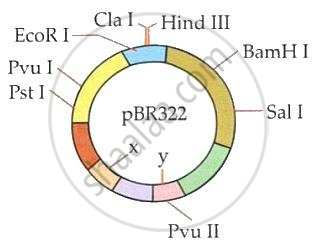
The following diagram showing restriction sites in E. coli cloning vector pBR322. Find the role of ‘X’ and ‘Y’ genes:
Which of the following is not a cloning vector?
What is the primary function of a vector in recombinant DNA technology?
What is the primary role of a cloning site in a vector?
Which vector derived from \(\textit{Agrobacterium tumefaciens}\) is utilized for delivering foreign genes into plants?
