Advertisements
Advertisements
Question
Give three hypotheses for explaining why tropics show greatest levels of species richness.
Advertisements
Solution
- Speciation is generally a function of time. Temperate regions have been repeatedly glaciated since ancient times, while tropical latitudes have remained undisturbed for millions of years. Hence, there has been more time for species to evolve and diversify.
- The tropical environment is different from the temperate environment and shows fewer seasonal changes. This stable environment has encouraged niche specialisation, leading to greater species diversity.
- More solar energy is available in tropical regions, which leads to greater productivity and, indirectly, to more extraordinary biodiversity.
APPEARS IN
RELATED QUESTIONS
Explain, giving three reasons, why tropics show greatest levels of species diversity.
What is the significance of the slope of regression in a species-area relationship?
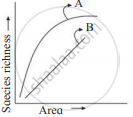
Observe the graph and select the correct option:
The 'rivet' in the rivet popper hypothesis is considered to represent the ______.
Extent of global diversity of invertebrates is shown in the pie diagram below. Choose the most appropriate alternative that the four portions (a-d) represent.

Latitudinal and altitudinal gradient is shown by which of the following habitat(s)?
Maximum species richness is observed in the ______.
Which of the following is an observation of Alexander von Humboldt's documented pattern in ecology?
Species richness - area relationship is given by ______.
The graph of species richness and area for a number of taxa like angiospermic plants, freshwater fishes, and birds is found to be ______.
Oxygen dissociation curve for Myoglobin has the following shape:
The pattern of biodiversity is affected by ______.
"Species richness increased with increased explored area but only a limit". This statement was given by.
Which one of the following is not a major characteristic feature of biodiversity hot spots?
Amongst the animal groups given below, which one appears to be more vulnerable to extinction?
Species diversity decreases as we move away from the equator towards the poles. What could be the possible reasons?
Study the graph given below:
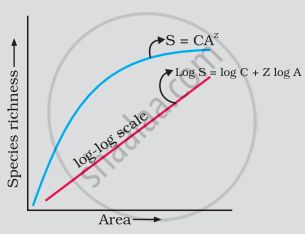
As per Alexander von Humboldt, what do the symbols S, A, Z and C in the graph stand for, in respect of a species and area relationship?
The species-area relationship is represented on a log scale as ______.
For frugivorous (fruit-eating) birds and mammals in the tropical forests of different continents, the slope of the species-area relationship is found to be approximately ______.
Which of the following hypothesis suggests that ecosystems are like aeroplanes where flight safety (ecosystem functioning) may or may not be compromised, depending upon which species are being lost?
Alexander von Humboldt observed that, within a region species richness ______ with increasing explored area.
Rivet Popper Hypothesis is an analogy to explain the significance of ______.
Who observed that within a region, species richness increased with increasing explored area, to a certain limit?
Which of the following characteristics are seen in a stable community?
- It is strong enough to withstand environmental disturbance and recovers quickly.
- It is resistant to invasive species.
- It exhibits constant change in biomass production over a period of time.
- It has more species diversity.
What does the variable Z represent in the species-area relationship formula log S = log C + Z log A?
For smaller areas, what is the typical range of the Z value (slope) in the species-area relationship?
For very large areas such as entire continents, what is the typical range of the Z value in the species-area relationship?
Which of the following ecosystems would be predicted to have the highest species richness based on the latitudinal and species-area principles?
