Advertisements
Advertisements
Question
The relation between species richness and area for a wide variety of taxa turns out to be a rectangular hyperbola. Give a brief explanation.
Advertisements
Solution
During his pioneering and extensive explorations in the wilderness of South American jungles, the great German naturalist and geographer Alexander von Humboldt observed that within a region species richness increased with the increasing explored area, but only up to a limit. In fact, the relation between species richness and area for a wide variety of taxa (angiosperm plants, birds, bats, freshwater fishes) turns out to be a rectangular hyperbola.
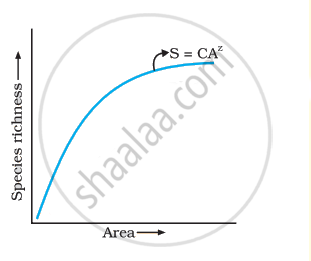
Species area relationship
APPEARS IN
RELATED QUESTIONS
The following graph shows the species-area relationship. Answer the following questions as directed.
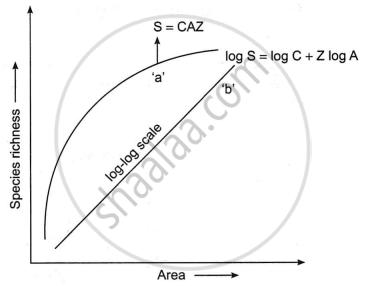
(a) Name the naturalist who studied the kind of relationship shown in the graph. Write the observations made by him.
(b) Write the situations as discovered by the ecologists when the value of ‘Z’
(Slope of the line) lies between:
- 0.1 and 0.2
- 0.6 and 1.2
What does ‘Z’ stand for?
(c) When would the slope of the line ‘b’ become steeper?
Give three hypotheses for explaining why tropics show greatest levels of species richness.
What is the significance of the slope of regression in a species-area relationship?
Short answer type question
Tropical regions exhibit species richness as compared to polar regions. Justify.
Which of the following hypothesis states: Rich species diversity leads to lesser variation in biomass production over a period of time.
All are true regarding graph showing species richness - area relationship, EXCEPT ______.
Which of the following countries has the highest biodiversity?
There is greater biodiversity in tropical /subtropical regions than in temperate region. Explain.
Species diversity decreases as we move away from the equator towards the poles. What could be the possible reasons?
Study the graph given below:
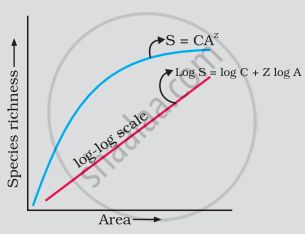
As per Alexander von Humboldt, what do the symbols S, A, Z and C in the graph stand for, in respect of a species and area relationship?
Lesser variation in biomass production over a period of time is called ______.
Distribution of diversity on earth shows that biodiversity from higher latitudes to lower latitudes ______.
For frugivorous (fruit-eating) birds and mammals in the tropical forests of different continents, the slope of the species-area relationship is found to be approximately ______.
Which of the following hypothesis suggests that ecosystems are like aeroplanes where flight safety (ecosystem functioning) may or may not be compromised, depending upon which species are being lost?
The latitudinal gradient describes a pattern where species richness is highest in which geographic region?
Which of the following statements correctly describes the relationship between latitude and biodiversity?
What does the variable S represent in the species-area formula log S = log C + Z log A?
In the species-area relationship formula log S = log C + Z log A, what does the variable A represent?
