Advertisements
Advertisements
प्रश्न
The relation between species richness and area for a wide variety of taxa turns out to be a rectangular hyperbola. Give a brief explanation.
Advertisements
उत्तर
During his pioneering and extensive explorations in the wilderness of South American jungles, the great German naturalist and geographer Alexander von Humboldt observed that within a region species richness increased with the increasing explored area, but only up to a limit. In fact, the relation between species richness and area for a wide variety of taxa (angiosperm plants, birds, bats, freshwater fishes) turns out to be a rectangular hyperbola.
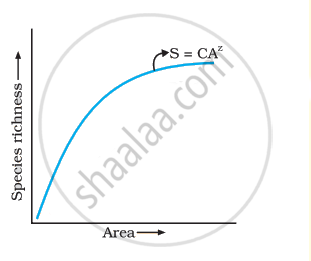
Species area relationship
APPEARS IN
संबंधित प्रश्न
The following graph shows the species-area relationship. Answer the following questions as directed.
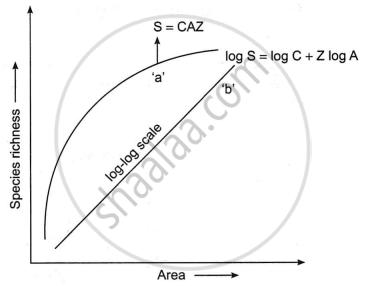
(a) Name the naturalist who studied the kind of relationship shown in the graph. Write the observations made by him.
(b) Write the situations as discovered by the ecologists when the value of ‘Z’
(Slope of the line) lies between:
- 0.1 and 0.2
- 0.6 and 1.2
What does ‘Z’ stand for?
(c) When would the slope of the line ‘b’ become steeper?
On a log scale the relationship of species richness and area becomes linear (straight line) and is given by the equation.
With reference to graph select the correct alternative
Oxygen dissociation curve for Myoglobin has the following shape:
Which of these is true about tropical environments?
The pattern of biodiversity is affected by ______.
What does the term ‘Frugivorous’ mean?
Given below is an equation describing the Species-Area relationship between species richness and area for a wide variety of taxa as angiosperm plants, birds, bats etc. S = CAz
- Give a graphical representation of the given equation showing Species-Area relationship.
- What does 'S' represent in the given equation?
- What is the value of 'Z' (regression coefficient) for frugivorous birds and mammals in the tropical forests of different continents?
Study the graph given below:
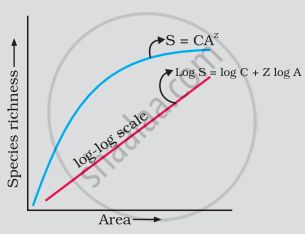
As per Alexander von Humboldt, what do the symbols S, A, Z and C in the graph stand for, in respect of a species and area relationship?
The species-area relationship is represented on a log scale as ______.
The relation between species richness and area for a wide variety of taxa appears as ______.
Rivet Popper Hypothesis is an analogy to explain the significance of ______.
Who observed that within a region, species richness increased with increasing explored area, to a certain limit?
When pre-reproductive and post - reproductive age group is same in structure, the population is______.
The altitudinal gradient describes a pattern where species diversity is greatest at which elevation?
For smaller areas, what is the typical range of the Z value (slope) in the species-area relationship?
For very large areas such as entire continents, what is the typical range of the Z value in the species-area relationship?
Which of the following ecosystems would be predicted to have the highest species richness based on the latitudinal and species-area principles?
