Advertisements
Advertisements
प्रश्न
What does the term ‘Frugivorous’ mean?
Advertisements
उत्तर
Frugivorous means fruit-eating organisms.
APPEARS IN
संबंधित प्रश्न
The following graph shows the species-area relationship. Answer the following questions as directed.
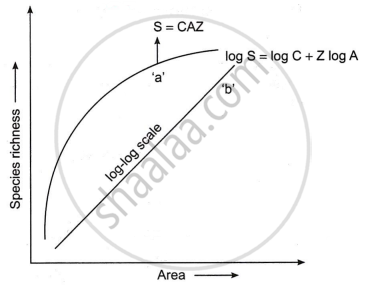
(a) Name the naturalist who studied the kind of relationship shown in the graph. Write the observations made by him.
(b) Write the situations as discovered by the ecologists when the value of ‘Z’
(Slope of the line) lies between:
- 0.1 and 0.2
- 0.6 and 1.2
What does ‘Z’ stand for?
(c) When would the slope of the line ‘b’ become steeper?
Which of the following hypothesis states: Rich species diversity leads to lesser variation in biomass production over a period of time.
Maximum species richness is observed in the ______.
In the equation: log S = log C + Z log A , S= species richness; Z = slope of line (regression coefficient); A = area; C = Y intercept. For smaller area, the value of Z ranges from ____________.
All are true regarding graph showing species richness - area relationship, EXCEPT ______.
Which of the following is an observation of Alexander von Humboldt's documented pattern in ecology?
Which of the below mentioned regions exhibit lees seasonal variations?
Which one of the following is not a major characteristic feature of biodiversity hot spots?
Species diversity decreases as we move away from the equator towards the poles. What could be the possible reasons?
The relation between species richness and area for a wide variety of taxa turns out to be a rectangular hyperbola. Give a brief explanation.
Write the inference drawn by Alexander von Humboldt after his extensive explorations of South American jungle.
Lesser variation in biomass production over a period of time is called ______.
The relation between species richness and area for a wide variety of taxa appears as ______.
Rivet Popper Hypothesis is an analogy to explain the significance of ______.
The latitudinal gradient describes a pattern where species richness is highest in which geographic region?
In the species-area relationship formula log S = log C + Z log A, what does the variable A represent?
For smaller areas, what is the typical range of the Z value (slope) in the species-area relationship?
Which of the following ecosystems would be predicted to have the highest species richness based on the latitudinal and species-area principles?
