Advertisements
Advertisements
प्रश्न
Given below is an equation describing the Species-Area relationship between species richness and area for a wide variety of taxa as angiosperm plants, birds, bats etc. S = CAz
- Give a graphical representation of the given equation showing Species-Area relationship.
- What does 'S' represent in the given equation?
- What is the value of 'Z' (regression coefficient) for frugivorous birds and mammals in the tropical forests of different continents?
Advertisements
उत्तर
- The given equation's graphical representation of the relationship between species and area is as follows:
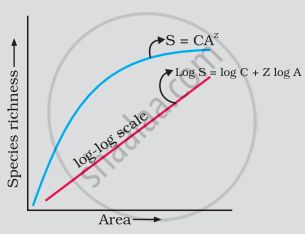
- The species richness is represented by S in the given equation.
- The regression coefficient Z is the slope of the line. The slope is found to be 1.15 for frugivorous (fruit-eating) birds and mammals in tropical woods on various continents.
संबंधित प्रश्न
The 'rivet' in the rivet popper hypothesis is considered to represent the ______.
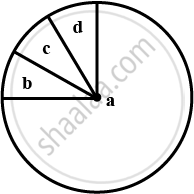
Extent of global diversity of invertebrates is shown in the pie diagram below. Choose the most appropriate alternative that the four portions (a-d) represent.
In the equation: log S = log C + Z log A , S= species richness; Z = slope of line (regression coefficient); A = area; C = Y intercept. For smaller area, the value of Z ranges from ____________.
Which of the following countries has the highest biodiversity?
Which one of the following is not a major characteristic feature of biodiversity hot spots?
A species-area curve is drawn by plotting the number of species against the area. How is it that when a very large area is considered the slope is steeper than that for smaller areas?
Is it possible that productivity and diversity of a natural community remain constant over a time period of, say one hundred years?
Is it true that there is more solar energy available in the tropics? Explain briefly.
Species diversity decreases as we move away from the equator towards the poles. What could be the possible reasons?
Who observed that within a region, species richness increased with increasing explored area, to a certain limit?
