Advertisements
Advertisements
Question
Given below is an equation describing the Species-Area relationship between species richness and area for a wide variety of taxa as angiosperm plants, birds, bats etc. S = CAz
- Give a graphical representation of the given equation showing Species-Area relationship.
- What does 'S' represent in the given equation?
- What is the value of 'Z' (regression coefficient) for frugivorous birds and mammals in the tropical forests of different continents?
Advertisements
Solution
- The given equation's graphical representation of the relationship between species and area is as follows:
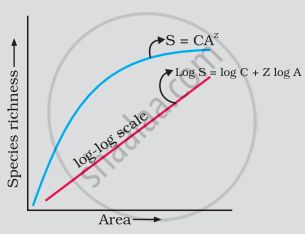
- The species richness is represented by S in the given equation.
- The regression coefficient Z is the slope of the line. The slope is found to be 1.15 for frugivorous (fruit-eating) birds and mammals in tropical woods on various continents.
RELATED QUESTIONS
Short answer type question
Tropical regions exhibit species richness as compared to polar regions. Justify.
Extent of global diversity of invertebrates is shown in the pie diagram below. Choose the most appropriate alternative that the four portions (a-d) represent.

Latitudinal and altitudinal gradient is shown by which of the following habitat(s)?
Species richness - area relationship is given by ______.
Oxygen dissociation curve for Myoglobin has the following shape:
Which of the following countries has the highest biodiversity?
Lesser variation in biomass production over a period of time is called ______.
Rivet Popper Hypothesis is an analogy to explain the significance of ______.
Match the scientist in column I with their contribution in column II and choose the correct option.
| Column I | Column II | ||
| i. | Alexander Van Humboldt | a. | Estimated 7 million species round the globe |
| ii. | Robert May | b. | Rivet popper hypothesis |
| iii. | David Tillman | c. | Species Area Relationship |
| iv. | Paul Ehrlich | d. | Productivity stability hypothesis |
Which of the following characteristics are seen in a stable community?
- It is strong enough to withstand environmental disturbance and recovers quickly.
- It is resistant to invasive species.
- It exhibits constant change in biomass production over a period of time.
- It has more species diversity.
