Advertisements
Advertisements
प्रश्न
Given below is an equation describing the Species-Area relationship between species richness and area for a wide variety of taxa as angiosperm plants, birds, bats etc. S = CAz
- Give a graphical representation of the given equation showing Species-Area relationship.
- What does 'S' represent in the given equation?
- What is the value of 'Z' (regression coefficient) for frugivorous birds and mammals in the tropical forests of different continents?
Advertisements
उत्तर
- The given equation's graphical representation of the relationship between species and area is as follows:
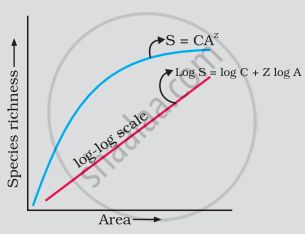
- The species richness is represented by S in the given equation.
- The regression coefficient Z is the slope of the line. The slope is found to be 1.15 for frugivorous (fruit-eating) birds and mammals in tropical woods on various continents.
संबंधित प्रश्न
Observe the graph and select the correct option:
Short answer type question
Tropical regions exhibit species richness as compared to polar regions. Justify.
Maximum species richness is observed in the ______.
With reference to graph select the correct alternative
Species richness - area relationship is given by ______.
Which of these is true about tropical environments?
Which one of the following is not a major characteristic feature of biodiversity hot spots?
For frugivorous (fruit-eating) birds and mammals in the tropical forests of different continents, the slope of the species-area relationship is found to be approximately ______.
Rivet Popper Hypothesis is an analogy to explain the significance of ______.
Which of the following statements correctly describes the relationship between latitude and biodiversity?
