Advertisements
Advertisements
Question
Short answer type question
Tropical regions exhibit species richness as compared to polar regions. Justify.
Advertisements
Solution
i. Factors like overall stability of tropical regions for millions of years, lesser climatic changes throughout the year, and availability of plenty of sunlight have favoured speciation.
ii. Tropical areas have less often experienced drastic disturbances like periodic glaciations observed at poles. Such stability over millions of years might have favoured speciation.
iii. Lesser migrations in tropics might have reduced gene flow between geographically isolated regions and favoured speciation.
iv. Scientists also have considered the availability of more intense sunlight, warmer temperatures and higher annual rainfall in tropics, as factors responsible for the bountifulness of these regions.
v. Some animals enjoy food preferences under climatic conditions and abundance of resources. e.g. Fruits being available throughout the year in rain forests, a variety of frugivorous organisms is obviously more as compared to the temperate regions.
vi. In short, species richness or diversity for plants and animals decreases as we move away from the equator to the poles. It is maximum in tropical rain forests.
e.g. Amazon rain forest (40,000 plants, 1300 birds, 427 mammals, 3000 species).
Hence, tropical regions exhibit species richness as compared to polar regions.
APPEARS IN
RELATED QUESTIONS
Explain, giving three reasons, why tropics show greatest levels of species diversity.
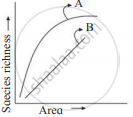
Observe the graph and select the correct option:
Amongst the animal group given below, which one has the highest percentage of endangered species?
Is it possible that productivity and diversity of a natural community remain constant over a time period of, say one hundred years?
Study the graph given below:
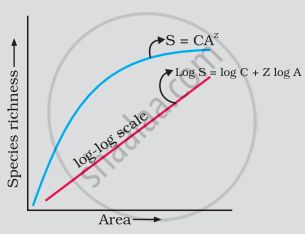
As per Alexander von Humboldt, what do the symbols S, A, Z and C in the graph stand for, in respect of a species and area relationship?
For frugivorous (fruit-eating) birds and mammals in the tropical forests of different continents, the slope of the species-area relationship is found to be approximately ______.
Alexander von Humboldt observed that, within a region species richness ______ with increasing explored area.
Rivet Popper Hypothesis is an analogy to explain the significance of ______.
Match the scientist in column I with their contribution in column II and choose the correct option.
| Column I | Column II | ||
| i. | Alexander Van Humboldt | a. | Estimated 7 million species round the globe |
| ii. | Robert May | b. | Rivet popper hypothesis |
| iii. | David Tillman | c. | Species Area Relationship |
| iv. | Paul Ehrlich | d. | Productivity stability hypothesis |
Which of the following statements correctly describes the relationship between latitude and biodiversity?
