Advertisements
Advertisements
प्रश्न
Short answer type question
Tropical regions exhibit species richness as compared to polar regions. Justify.
Advertisements
उत्तर
i. Factors like overall stability of tropical regions for millions of years, lesser climatic changes throughout the year, and availability of plenty of sunlight have favoured speciation.
ii. Tropical areas have less often experienced drastic disturbances like periodic glaciations observed at poles. Such stability over millions of years might have favoured speciation.
iii. Lesser migrations in tropics might have reduced gene flow between geographically isolated regions and favoured speciation.
iv. Scientists also have considered the availability of more intense sunlight, warmer temperatures and higher annual rainfall in tropics, as factors responsible for the bountifulness of these regions.
v. Some animals enjoy food preferences under climatic conditions and abundance of resources. e.g. Fruits being available throughout the year in rain forests, a variety of frugivorous organisms is obviously more as compared to the temperate regions.
vi. In short, species richness or diversity for plants and animals decreases as we move away from the equator to the poles. It is maximum in tropical rain forests.
e.g. Amazon rain forest (40,000 plants, 1300 birds, 427 mammals, 3000 species).
Hence, tropical regions exhibit species richness as compared to polar regions.
APPEARS IN
संबंधित प्रश्न
Observe the graph and select the correct option:
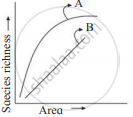
Which of the following is an observation of Alexander von Humboldt's documented pattern in ecology?
Which one of the following is not a major characteristic feature of biodiversity hot spots?
A species-area curve is drawn by plotting the number of species against the area. How is it that when a very large area is considered the slope is steeper than that for smaller areas?
Given below is an equation describing the Species-Area relationship between species richness and area for a wide variety of taxa as angiosperm plants, birds, bats etc. S = CAz
- Give a graphical representation of the given equation showing Species-Area relationship.
- What does 'S' represent in the given equation?
- What is the value of 'Z' (regression coefficient) for frugivorous birds and mammals in the tropical forests of different continents?
Study the graph given below:
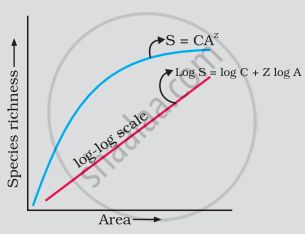
As per Alexander von Humboldt, what do the symbols S, A, Z and C in the graph stand for, in respect of a species and area relationship?
Distribution of diversity on earth shows that biodiversity from higher latitudes to lower latitudes ______.
Alexander von Humboldt observed that, within a region species richness ______ with increasing explored area.
When pre-reproductive and post - reproductive age group is same in structure, the population is______.
The altitudinal gradient describes a pattern where species diversity is greatest at which elevation?
