Advertisements
Advertisements
प्रश्न
Study the graph given below:
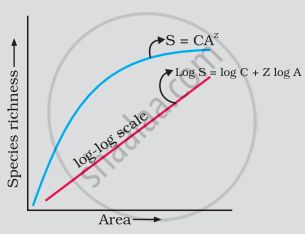
As per Alexander von Humboldt, what do the symbols S, A, Z and C in the graph stand for, in respect of a species and area relationship?
Advertisements
उत्तर
On a logarithmic scale, the relationship is a straight line described by the equation,
log S = log C + Z log A
where,
S = Species richness
A = Area
Z = slope of the line (regression coefficient)
C = Y-intercept
संबंधित प्रश्न
Observe the graph and select the correct option:
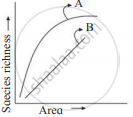
Latitudinal and altitudinal gradient is shown by which of the following habitat(s)?
In the equation: log S = log C + Z log A , S= species richness; Z = slope of line (regression coefficient); A = area; C = Y intercept. For smaller area, the value of Z ranges from ____________.
Which of the below mentioned regions exhibit lees seasonal variations?
Which of these is true about tropical environments?
Which of these is true about tropical environments?
There is greater biodiversity in tropical /subtropical regions than in temperate region. Explain.
Distribution of diversity on earth shows that biodiversity from higher latitudes to lower latitudes ______.
Alexander von Humboldt developed observations leading to the discovery of which relationship in ecology?
What does the variable C represent in the species-area relationship formula log S = log C + Z log A?
