Advertisements
Advertisements
प्रश्न
Study the graph given below:
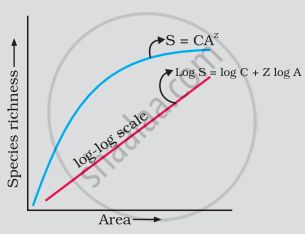
As per Alexander von Humboldt, what do the symbols S, A, Z and C in the graph stand for, in respect of a species and area relationship?
Advertisements
उत्तर
On a logarithmic scale, the relationship is a straight line described by the equation,
log S = log C + Z log A
where,
S = Species richness
A = Area
Z = slope of the line (regression coefficient)
C = Y-intercept
संबंधित प्रश्न
Short answer type question
Tropical regions exhibit species richness as compared to polar regions. Justify.
All are true regarding graph showing species richness - area relationship, EXCEPT ______.
Which of the following is an observation of Alexander von Humboldt's documented pattern in ecology?
Amongst the animal group given below, which one has the highest percentage of endangered species?
"Species richness increased with increased explored area but only a limit". This statement was given by.
Species diversity decreases as we move away from the equator towards the poles. What could be the possible reasons?
The species-area relationship is represented on a log scale as ______.
Alexander von Humboldt observed that, within a region species richness ______ with increasing explored area.
Which of the following characteristics are seen in a stable community?
- It is strong enough to withstand environmental disturbance and recovers quickly.
- It is resistant to invasive species.
- It exhibits constant change in biomass production over a period of time.
- It has more species diversity.
Which of the following statements correctly describes the relationship between latitude and biodiversity?
