Advertisements
Advertisements
Question
Study the graph given below:
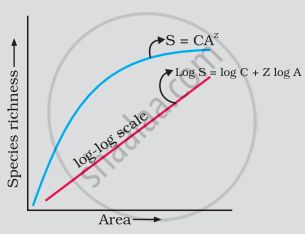
As per Alexander von Humboldt, what do the symbols S, A, Z and C in the graph stand for, in respect of a species and area relationship?
Advertisements
Solution
On a logarithmic scale, the relationship is a straight line described by the equation,
log S = log C + Z log A
where,
S = Species richness
A = Area
Z = slope of the line (regression coefficient)
C = Y-intercept
RELATED QUESTIONS
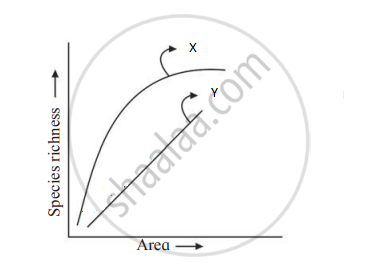
On a log scale the relationship of species richness and area becomes linear (straight line) and is given by the equation.
Select the correct alternative for x and y.
Oxygen dissociation curve for Myoglobin has the following shape:
Which of these is true about tropical environments?
Amongst the animal groups given below, which one appears to be more vulnerable to extinction?
Given below is an equation describing the Species-Area relationship between species richness and area for a wide variety of taxa as angiosperm plants, birds, bats etc. S = CAz
- Give a graphical representation of the given equation showing Species-Area relationship.
- What does 'S' represent in the given equation?
- What is the value of 'Z' (regression coefficient) for frugivorous birds and mammals in the tropical forests of different continents?
Write the inference drawn by Alexander von Humboldt after his extensive explorations of South American jungle.
Which of the following hypothesis suggests that ecosystems are like aeroplanes where flight safety (ecosystem functioning) may or may not be compromised, depending upon which species are being lost?
When pre-reproductive and post - reproductive age group is same in structure, the population is______.
Which of the following environmental conditions becomes harsher as altitude increases on a mountain slope?
