Advertisements
Advertisements
प्रश्न
The following graph shows the species-area relationship. Answer the following questions as directed.
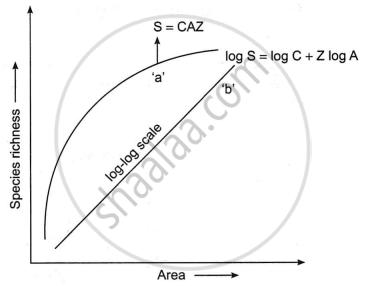
(a) Name the naturalist who studied the kind of relationship shown in the graph. Write the observations made by him.
(b) Write the situations as discovered by the ecologists when the value of ‘Z’
(Slope of the line) lies between:
- 0.1 and 0.2
- 0.6 and 1.2
What does ‘Z’ stand for?
(c) When would the slope of the line ‘b’ become steeper?
Advertisements
उत्तर १
(a) The German naturalist and geographer Alexander von Humboldt studied the species–area relationship. He found that species richness within a region increased with increasing area but up to a certain limit. The relationship between species richness and area turned out to be rectangular hyperbola for a wide variety of taxa.
(b)
(i) If the value of Z lies in the range of 0.1−0.2, then it is regardless of taxonomic group or region.
(ii) If the value of Z lies in the range of 0.6−1.2, then the slope of the line will be much steeper.
Z stands for the slope of the line or regression coefficient.
(c) If the species–area relationship is for very large areas such as the entire continent, then the slope of the line will be much steeper.
उत्तर २
(a) The naturalist who studied this relationship was Alexander von Humboldt. He observed that within a region, species richness increased with increasing explored area, but only up to a limit. When plotted, the relation between species richness and area for various taxa forms a rectangular hyperbola. On a logarithmic scale, this becomes a straight line described by the equation:
log S = log C + Z log A
where,
(S) = species richness,
(A) = area,
(Z) = slope of the line (regression coefficient)
(C) = Y-intercept
(b)
- When (Z) lies between 0.1 and 0.2, ecologists have found this range regardless of the taxonomic group or region when the explored area is limited (smaller areas).
- When (Z) lies between 0.6 and 1.2, it occurs for very large areas such as entire continents, where the slope of the line is much steeper.
‘Z’ stands for the regression coefficient or slope of the line in the species-area relationship.
(c) The slope of the line ‘b’ becomes steeper when the explored area increases, such as when moving from smaller regions to very large regions like continents.
संबंधित प्रश्न
Short answer type question
Tropical regions exhibit species richness as compared to polar regions. Justify.
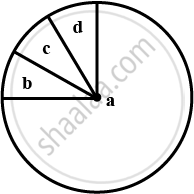
Extent of global diversity of invertebrates is shown in the pie diagram below. Choose the most appropriate alternative that the four portions (a-d) represent.
Which of the following hypothesis states: Rich species diversity leads to lesser variation in biomass production over a period of time.
All are true regarding graph showing species richness - area relationship, EXCEPT ______.
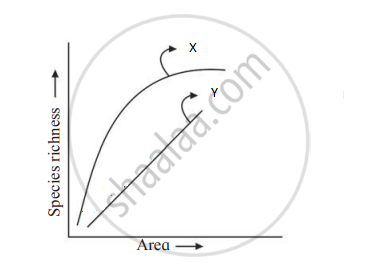
Select the correct alternative for x and y.
"Species richness increased with increased explored area but only a limit". This statement was given by.
Which of the following countries has the highest biodiversity?
Is it possible that productivity and diversity of a natural community remain constant over a time period of, say one hundred years?
Distribution of diversity on earth shows that biodiversity from higher latitudes to lower latitudes ______.
Which of the following characteristics are seen in a stable community?
- It is strong enough to withstand environmental disturbance and recovers quickly.
- It is resistant to invasive species.
- It exhibits constant change in biomass production over a period of time.
- It has more species diversity.
