Advertisements
Advertisements
प्रश्न
The following graph shows the species-area relationship. Answer the following questions as directed.
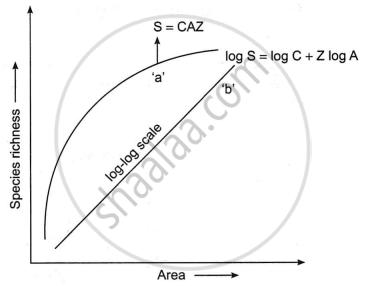
(a) Name the naturalist who studied the kind of relationship shown in the graph. Write the observations made by him.
(b) Write the situations as discovered by the ecologists when the value of ‘Z’
(Slope of the line) lies between:
- 0.1 and 0.2
- 0.6 and 1.2
What does ‘Z’ stand for?
(c) When would the slope of the line ‘b’ become steeper?
Advertisements
उत्तर १
(a) The German naturalist and geographer Alexander von Humboldt studied the species–area relationship. He found that species richness within a region increased with increasing area but up to a certain limit. The relationship between species richness and area turned out to be rectangular hyperbola for a wide variety of taxa.
(b)
(i) If the value of Z lies in the range of 0.1−0.2, then it is regardless of taxonomic group or region.
(ii) If the value of Z lies in the range of 0.6−1.2, then the slope of the line will be much steeper.
Z stands for the slope of the line or regression coefficient.
(c) If the species–area relationship is for very large areas such as the entire continent, then the slope of the line will be much steeper.
उत्तर २
(a) The naturalist who studied this relationship was Alexander von Humboldt. He observed that within a region, species richness increased with increasing explored area, but only up to a limit. When plotted, the relation between species richness and area for various taxa forms a rectangular hyperbola. On a logarithmic scale, this becomes a straight line described by the equation:
log S = log C + Z log A
where,
(S) = species richness,
(A) = area,
(Z) = slope of the line (regression coefficient)
(C) = Y-intercept
(b)
- When (Z) lies between 0.1 and 0.2, ecologists have found this range regardless of the taxonomic group or region when the explored area is limited (smaller areas).
- When (Z) lies between 0.6 and 1.2, it occurs for very large areas such as entire continents, where the slope of the line is much steeper.
‘Z’ stands for the regression coefficient or slope of the line in the species-area relationship.
(c) The slope of the line ‘b’ becomes steeper when the explored area increases, such as when moving from smaller regions to very large regions like continents.
संबंधित प्रश्न
Give three hypotheses for explaining why tropics show greatest levels of species richness.
Observe the graph and select the correct option:
Short answer type question
Tropical regions exhibit species richness as compared to polar regions. Justify.
Maximum species richness is observed in the ______.
With reference to graph select the correct alternative
The graph of species richness and area for a number of taxa like angiospermic plants, freshwater fishes, and birds is found to be ______.
Oxygen dissociation curve for Myoglobin has the following shape:
The pattern of biodiversity is affected by ______.
Write the inference drawn by Alexander von Humboldt after his extensive explorations of South American jungle.
The relation between species richness and area for a wide variety of taxa appears as ______.
