Advertisements
Advertisements
प्रश्न
Which of the below mentioned regions exhibit lees seasonal variations?
विकल्प
Tropics
Temperates
Alpines
Both Tropics and Temperates
Advertisements
उत्तर
Tropics
Explanation:
The tropics have the most biodiversity because they have less seasonal fluctuations and hence remain undisturbed.
Temperate environments are more seasonal, have less Wnstand, and have fewer species variety; yet, alpine locations with cold temperatures and high elevations have diversity.
APPEARS IN
संबंधित प्रश्न
Explain, giving three reasons, why tropics show greatest levels of species diversity.
Observe the graph and select the correct option:
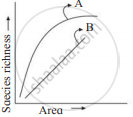
Short answer type question
Tropical regions exhibit species richness as compared to polar regions. Justify.
Extent of global diversity of invertebrates is shown in the pie diagram below. Choose the most appropriate alternative that the four portions (a-d) represent.

Species richness - area relationship is given by ______.
Amongst the animal group given below, which one has the highest percentage of endangered species?
Which of these is true about tropical environments?
Is it possible that productivity and diversity of a natural community remain constant over a time period of, say one hundred years?
Distribution of diversity on earth shows that biodiversity from higher latitudes to lower latitudes ______.
For frugivorous (fruit-eating) birds and mammals in the tropical forests of different continents, the slope of the species-area relationship is found to be approximately ______.
Alexander von Humboldt observed that, within a region species richness ______ with increasing explored area.
Rivet Popper Hypothesis is an analogy to explain the significance of ______.
Which of the following statements correctly describes the relationship between latitude and biodiversity?
The altitudinal gradient describes a pattern where species diversity is greatest at which elevation?
What does the variable Z represent in the species-area relationship formula log S = log C + Z log A?
What does the variable C represent in the species-area relationship formula log S = log C + Z log A?
For smaller areas, what is the typical range of the Z value (slope) in the species-area relationship?
Which of the following ecosystems would be predicted to have the highest species richness based on the latitudinal and species-area principles?
