Advertisements
Advertisements
प्रश्न
The relation between species richness and area for a wide variety of taxa turns out to be a rectangular hyperbola. Give a brief explanation.
Advertisements
उत्तर
During his pioneering and extensive explorations in the wilderness of South American jungles, the great German naturalist and geographer Alexander von Humboldt observed that within a region species richness increased with the increasing explored area, but only up to a limit. In fact, the relation between species richness and area for a wide variety of taxa (angiosperm plants, birds, bats, freshwater fishes) turns out to be a rectangular hyperbola.
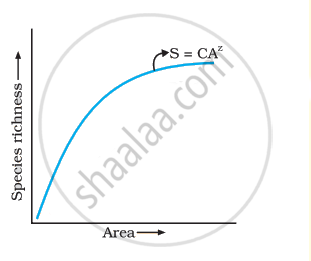
Species area relationship
APPEARS IN
संबंधित प्रश्न
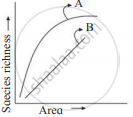
Observe the graph and select the correct option:
The 'rivet' in the rivet popper hypothesis is considered to represent the ______.
Which of the following hypothesis states: Rich species diversity leads to lesser variation in biomass production over a period of time.
On a log scale the relationship of species richness and area becomes linear (straight line) and is given by the equation.
Which of the following is an observation of Alexander von Humboldt's documented pattern in ecology?
The graph of species richness and area for a number of taxa like angiospermic plants, freshwater fishes, and birds is found to be ______.
Which of the below mentioned regions exhibit lees seasonal variations?
The pattern of biodiversity is affected by ______.
Which of the following countries has the highest biodiversity?
Is it possible that productivity and diversity of a natural community remain constant over a time period of, say one hundred years?
There is greater biodiversity in tropical /subtropical regions than in temperate region. Explain.
Is it true that there is more solar energy available in the tropics? Explain briefly.
Which of the following hypothesis suggests that ecosystems are like aeroplanes where flight safety (ecosystem functioning) may or may not be compromised, depending upon which species are being lost?
Which of the following characteristics are seen in a stable community?
- It is strong enough to withstand environmental disturbance and recovers quickly.
- It is resistant to invasive species.
- It exhibits constant change in biomass production over a period of time.
- It has more species diversity.
The latitudinal gradient describes a pattern where species richness is highest in which geographic region?
The altitudinal gradient describes a pattern where species diversity is greatest at which elevation?
Which of the following environmental conditions becomes harsher as altitude increases on a mountain slope?
